Explanation
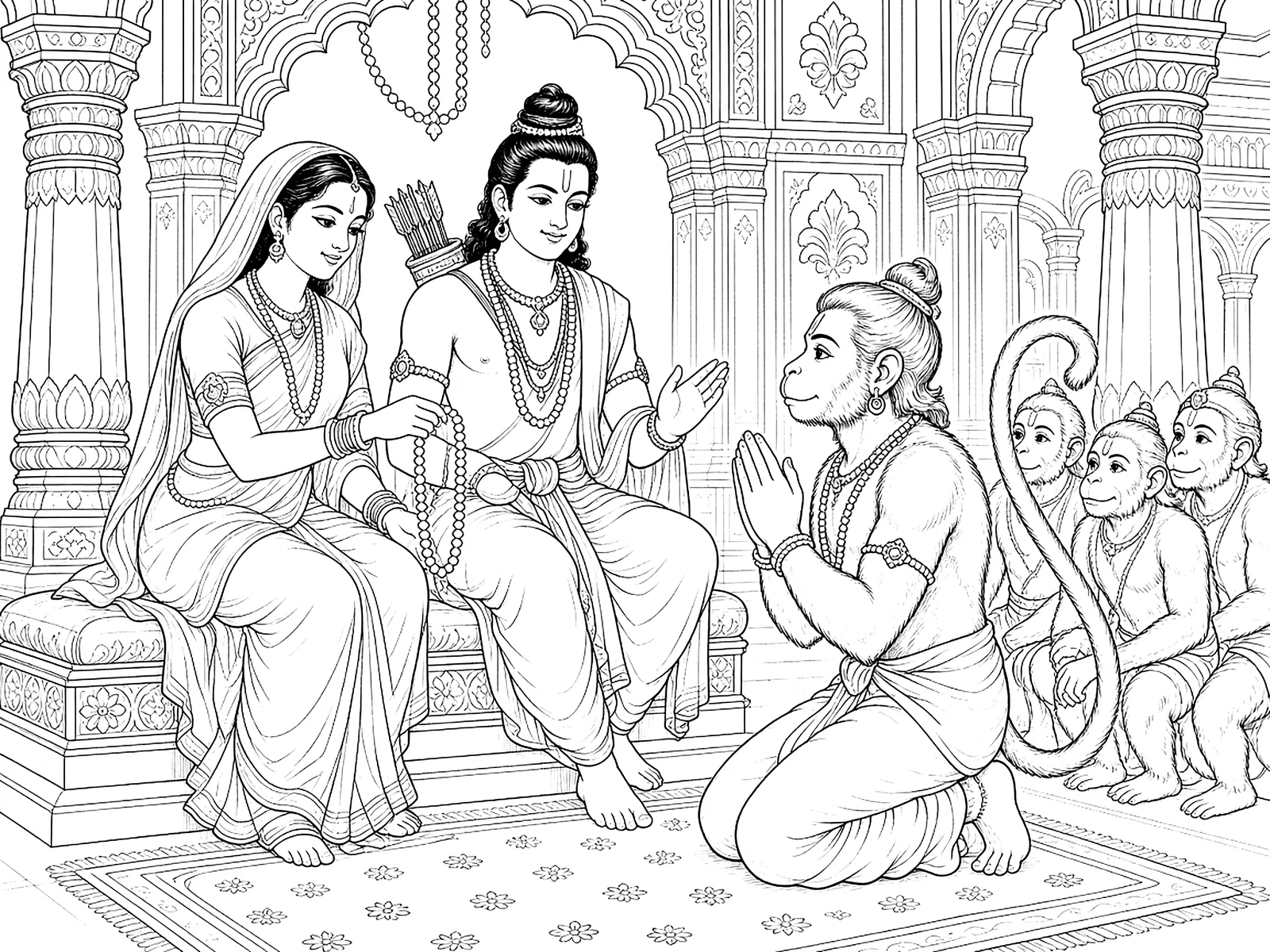
Sītā now gives gifts of her own. She has received two spotless divine garments and auspicious ornaments, and she gives them to Hanumān, the son of the Wind, looking toward Rāma as she does so. Her glance is a request for his approval, so that the gift is made in his presence and with his consent. The gift is a response to Hanumān's great service, the finding of Sītā in Laṅkā, and the verse prepares for the more famous gift of the necklace in the next verses.
Detailed Explanation
1. Line 1
अरजे वाससी दिव्ये शुभान्याभरणानि च ।
araje vāsasī divye śubhānyābharaṇāni ca |
Translation: Two spotless garments, divine, and auspicious ornaments,
Word meanings:
- araje (अरजे) – spotless; accusative dual
- vāsasī (वाससी) – two garments; accusative dual
- divye (दिव्ये) – divine; accusative dual
- śubhāni (शुभानि) – auspicious; accusative plural
- ābharaṇāni (आभरणानि) – ornaments; accusative plural
- ca (च) – and
Interpretation (elaborative):
Sītā now has something to give. Arajē vāsasī divye, "two spotless, divine garments", is a dual phrase in which araja, "free from dust", means more than clean: it is the word for the absence of rajas, passion or dust, so the garments are pure in a double sense. Śubhāni ābharaṇāni ca, "and auspicious ornaments", adds the second item. The things listed are now in the gift of Sītā, who has become the donor. The line is the first in the sarga where a woman gives a gift of her own, and the poem makes the gifts personal in kind: clothes and jewels, the possessions of the wearer. The dual vāsasī suggests an upper and a lower garment, a full set of clothing. The choice of gifts is also revealing. Clothing and ornaments are things a person wears next to the body, and giving them to Hanumān is an intimate act, one that treats him as a member of the family and not as a distant servant.
2. Line 2
अवेक्षमाणा वैदेही प्रददौ वायुसूनवे
avekṣamāṇā vaidehī pradadau vāyusūnave
Translation: Vaidehī, looking [toward Rāma], gave them to the son of Vāyu.
Word meanings:
- avekṣamāṇā (अवेक्षमाणा) – looking [toward Rāma]; present participle, middle (अव + √ईक्ष्)
- vaidehī (वैदेही) – Vaidehī; nominative singular
- pradadau (प्रददौ) – gave (them); perfect, third singular
- vāyusūnave (वायुसूनवे) – to the son of Vāyu; dative singular
Interpretation (elaborative):
The giver looks first: avekṣamāṇā vaidehī, "Vaidehī looking", where the participle says that her gift is made with a glance. The bracketed "toward Rāma" in the translation is the sense: she seeks his consent before giving. The recipient is vāyu-sūnave, "to the son of Vāyu", that is, Hanumān. The poet uses the patronymic again, avoiding his name, as he did in verse 39. The title vaidehī, "princess of Videha", comes in at the moment of her giving, and it recalls her origin as the daughter of Janaka, a king famous for his wisdom. The gift to Hanumān is therefore a gift from a princess to the servant who found her, and the glance to her husband shows how a queen gives with her lord's permission. The effect of the glance is to make the giving a joint act of the couple. Sītā does not decide alone, and the audience sees the harmony of two people who consult each other without a word.