Explanation
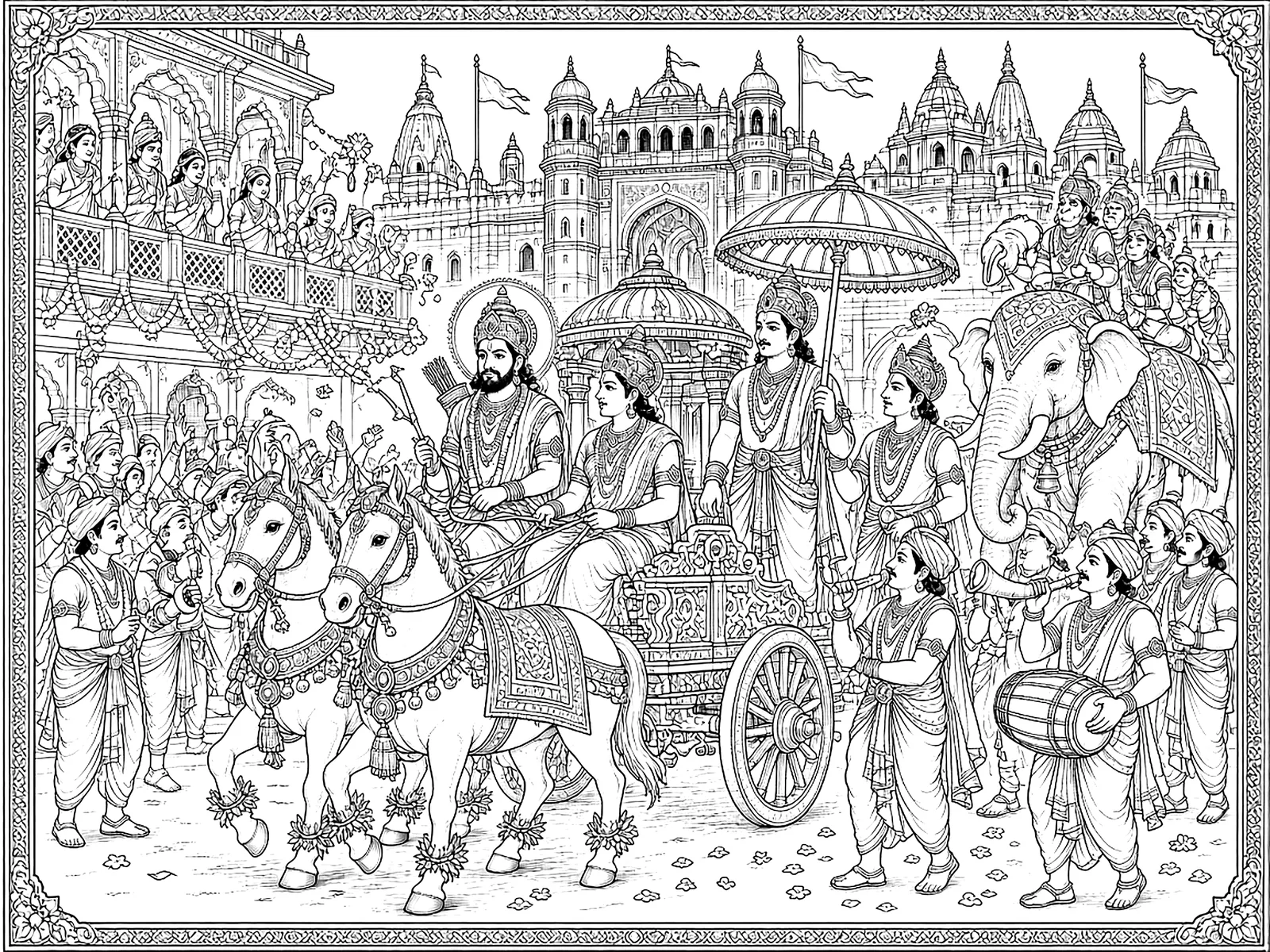
The ministers complete their instructions and set out to meet the returning king. The poet's language is rapid (tūrṇam) and the mood eager (rāmadarśanabuddhayaḥ); the old statesmen are like children who cannot wait. The verse also closes the Ayodhyā-side planning and returns the narrative to the procession itself, now approaching the city gates. In a story of such large events, the poet shows the simple longing of ordinary people to see their beloved king.
Detailed Explanation
1. Line 1
इति ते मन्त्रिणः सर्वे सन्दिश्य तु पुरोहितम् ।
iti te mantriṇaḥ sarve sandiśya tu purohitam |
Translation: Having thus instructed the priest, all those ministers
Word meanings:
- iti (इति) – thus
- te (ते) – those
- mantriṇaḥ (मन्त्रिणः) – ministers; nominative plural
- sarve (सर्वे) – all
- sandiśya (सन्दिश्य) – having instructed; gerund (sam + √दिश्)
- tu (तु) – indeed (a particle, not rendered separately)
- purohitam (पुरोहितम्) – the priest; accusative
Interpretation (elaborative):
The line is a closing of the council's business: iti, "thus", marks the end of the speech, and the gerund sandiśya, "having instructed", shows that the ministers hand the duty over to the priest. The word purohitam places him again as the person who stays and arranges, while the ministers themselves move out. Te mantriṇaḥ sarve, "those ministers, all", underlines that none remained behind: every one of the old counsellors wanted to leave the city. The sentence is structured like an official dispatch, with its "thus" and its "having instructed", and the reader feels the businesslike tone of a court that knows how to hand work to the right person. Behind the correctness, however, the next line will show the emotion that made them hurry. The effect of the correct formula followed by the swift exit is slightly comic, and the poet seems to enjoy it. A scene of careful government is closed in a line, and the real subject of the verse, longing, takes over in the very next words.
2. Line 2
नगरान्निर्ययुस्तूर्णं रामदर्शनबुद्धयः
nagarānniryayustūrṇaṃ rāmadarśanabuddhayaḥ
Translation: swiftly left the city, their minds set on seeing Rāma.
Word meanings:
- nagarāt (नगरात्) – from the city; ablative
- niryayuḥ (निर्ययुः) – left; perfect (nir + √या)
- tūrṇam (तूर्णम्) – swiftly; adverb
- rāmadarśanabuddhayaḥ (रामदर्शनबुद्धयः) – with minds set on seeing Rāma; राम-दर्शन-बुद्धि, bahuvrīhi
Interpretation (elaborative):
Tūrṇam, "swiftly", is the key word, and the compound rāma-darśana-buddhayaḥ, "with minds fixed on seeing Rāma", gives the reason. Buddhi is mind or intention, so the ministers are not just going to see him; their whole minds have become the wish to do so. Elderly officials moving fast, forgetting dignity, show what fourteen years of waiting have done. The verb niryayuḥ, "they went out", completes the movement from city to road. This is the poem's way of shifting scenes: the narrator leaves the planning room and joins the procession. Nothing needs to be said about the meeting between the ministers and Rāma, because the haste of the departure says it already. This line also closes the account of the preparations in Ayodhyā. The poet will not return to the city's side until the procession reaches it, and the ministers' haste carries the narrative across the intervening ground in a single image of old men hurrying to a meeting.