Explanation
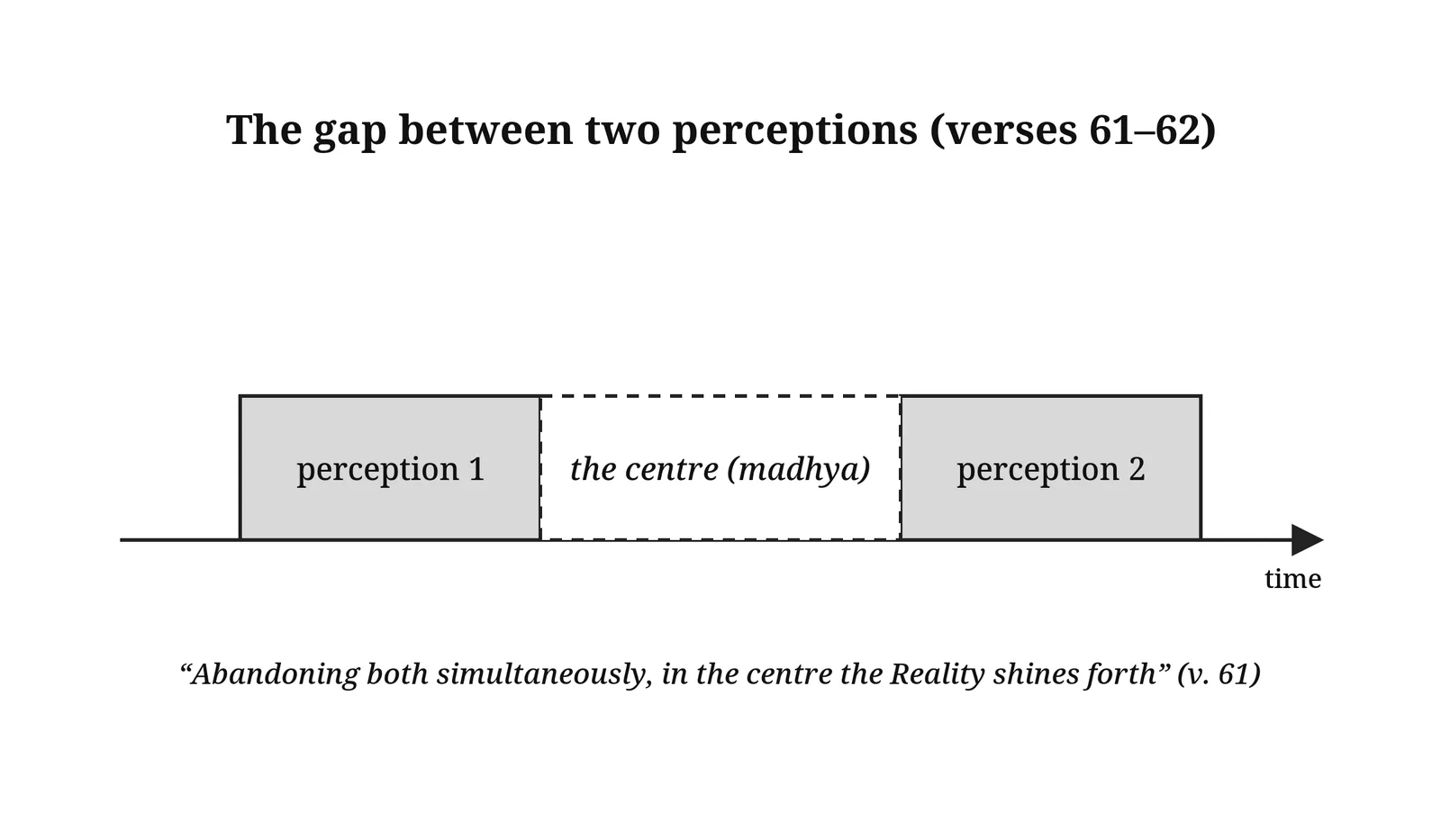
Dhāraṇā 38 is one of the most famous and subtle practices of the Tantra. When the mind moves from one object to another, there is a gap, a "middle" (madhya), between the two perceptions. The meditator attends to this middle, releases both objects simultaneously, and in the gap, reality shines. The verse is a key source of the Trika teaching on madhya. For the seeker, it shows that the Supreme is always present between thoughts and perceptions.
Detailed Explanation
1. उभयोर्भावयोर्ज्ञाने ध्यात्वा मध्यं समाश्रयेत् (ubhayor bhāvayor jñāne dhyātvā madhyaṃ samāśrayet):
“At the moment of knowing two objects, having meditated [on the space between them], one should take refuge in the centre;”
- उभयोः (ubhayoḥ) (gen./loc. du. of ubha): Two — of both; genitive dual of ubha.
- भावयोः (bhāvayoḥ) (gen./loc. du. m. of bhāva): Of two objects/things; genitive dual of bhāva.
- ज्ञाने (jñāne) (jñāna ← √jñā; loc. sg. n.): In the knowing, at the time of knowledge.
- ध्यात्वा (dhyātvā) (√dhyai, 1P; abs.): Having meditated.
- मध्यम् (madhyam) (acc. sg. n. of madhya): The centre — the middle, the centre.
- समाश्रयेत् (samāśrayet) (sam-ā-√śri, 1U; opt. 3sg.): Should take refuge in — should resort to, take refuge in; optative of sam-ā-√śri.
Interpretation (elaborative): When the mind knows (jñāne) two objects (ubhayor bhāvayoḥ), it moves from the first to the second. Between them there is a madhya, a middle: the moment when the first has been left and the second not yet grasped. Ordinarily this moment passes unnoticed, because the mind rushes from one object to the next. The dhāraṇā asks us to meditate on this transition and take refuge in the middle (madhyaṃ samāśrayet). Kṣemarāja comments in the Spanda-nirṇaya that the middle between two thoughts is where the spanda, the vibration of pure consciousness, is revealed: it is the "gap" through which the light of awareness shines unobstructed. The Spanda Kārikā (3.9) speaks of the unmeṣa, the "opening of the eye" of consciousness, that occurs between two thoughts. For the practitioner: look at one object, then at another. Notice the moment of shifting between them. Rather than hurrying to the second object, rest for a moment in the transition. It may feel like a tiny gap of nothingness or a subtle shift of awareness. With practice, the gap becomes more noticeable and more spacious. One can practise with two thoughts, two sounds or two words as well as two visual objects. Samāśrayet, "one should take refuge in", suggests that the centre between perceptions is not merely a point of attention but a shelter, a home. Śivopādhyāya connects this with the madhya of verses 24–26, the centre between breaths. The same centre appears between any two perceptions, between two thoughts, between two experiences. It is always present, always available as a refuge from the restless movement of the mind.
2. युगपच्च द्वयं त्यक्त्वा मध्ये तत्त्वं प्रकाशते (yugapac ca dvayaṃ tyaktvā madhye tattvaṃ prakāśate):
“abandoning both simultaneously, in the centre the Reality shines forth.”
- युगपत् (yugapat) (indecl.): Simultaneously; युगपत् + च → युगपच्च.
- च (ca) (indecl.): And.
- द्वयम् (dvayam) (acc. sg. n. of dvaya): Both, the pair.
- त्यक्त्वा (tyaktvā) (√tyaj, 1P; abs.): Having abandoned.
- मध्ये (madhye) (loc. sg. n.): In the centre — in the middle.
- तत्त्वम् (tattvam) (nom. sg. n.): Reality.
- प्रकाशते (prakāśate) (pra-√kāś, 1Ā; pres. 3sg.): Shines.
Interpretation (elaborative): The second step is to yugapat dvayaṃ tyaktvā, abandon both objects simultaneously. Not just the first, not just the second, but both at once. When one stands in the middle and lets go of both sides, there is nothing left but the middle itself, and madhye tattvaṃ prakāśate, in the middle reality shines. This is one of the most profound teachings of the Tantra and is often cited by Kṣemarāja. It parallels the Buddhist Madhyamaka, the Middle Way, though in the Trika the middle is not merely the avoidance of extremes but the luminous centre of consciousness itself. The madhya is the suṣumnā in the body, the balance between prāṇa and apāna, the gap between thoughts and the essence of the Self. All these are forms of the same centre. For the practitioner: when resting in the gap between two objects, consciously let go of both. Do not reach back to the first or forward to the second. Just remain in the middle. In that letting go, there may be a sudden clarity, a sense of open, aware presence, which is the reality (tattva) shining. With practice, one discovers that this middle is not a momentary gap but the ever-present background of all experience.
Practice Guide
Practice Guide — Dhāraṇā 38 (verse 61)
Preparation & Posture
Sit comfortably with eyes open, in a place with at least two distinct objects in view, or with two distinct sounds or sensations available. The practice concerns the moment between two perceptions. Relax the body and breathe naturally. See Figure 8.
Step-by-Step Method
1. Choose two objects (two points on a wall, for example) and look at one.
2. Move the gaze to the second object.
3. Notice the moment between the two, when the first has been left and the second not yet taken up.
4. Return to the first object and repeat the movement slowly several times.
5. Each time, rest in the centre (madhya) between the two.
6. Now hold both objects in awareness, then abandon both "simultaneously", as the verse says.
7. Rest in the centre that remains, where the verse says Reality shines forth.
8. End by looking around the room and continuing your activity.
What to notice. At first the gap between two perceptions is hardly noticeable; the gaze jumps quickly. Slow the movement and notice the brief moment of not-knowing. Over time this moment becomes clearer and more spacious. When both objects are abandoned, notice a bright, open awareness that is not focused on anything.
Beginner variation: use two sounds, such as two strokes of a bell, and notice the silence between them.
Duration & Frequency
Beginners: 5–10 minutes. Established practitioners: 15–20 minutes, and also briefly during the day.
Signs of Progress
The gap between perceptions becomes vivid and easy to find; it seems to widen into a stable centre; the mind becomes still and open; afterwards a sense of freshness and clarity, and an ability to notice the gaps between activities during the day.
Common Mistakes
Rushing the movement of the gaze; analysing what the gap "is"; holding the eyes rigid; missing the gap because attention jumps straight to the second object; turning the practice into concentration on the objects rather than on the centre between them.
Cautions
A gentle practice; avoid eye strain by blinking normally.
Integration into Daily Life
When moving the gaze from one task to another, notice the moment in between.
Related dhāraṇās: continues in Dhāraṇā 39 (verse 62); compare Dhāraṇā 97 (verse 122) and see Figure 8.
Traditional guidance, not medical advice; see “A Note on Safe Practice” in the Introduction.
- Variant: according to Jaideva Singh, Jayaratha (commentary on Tantrāloka I) reads jñātvā (“having known”) for dhyātvā, a reading Singh considers better.