Explanation
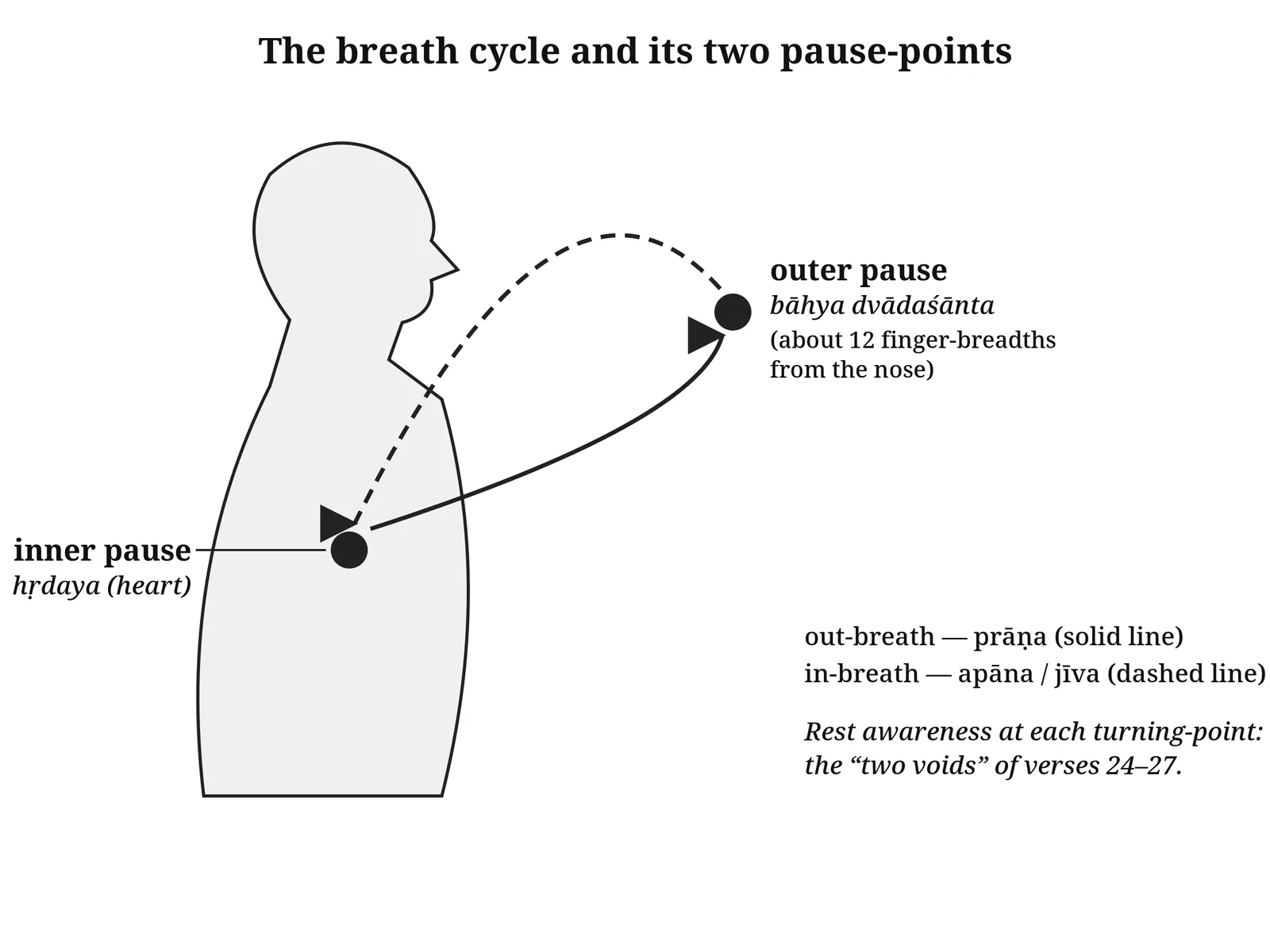
With this verse Bhairava begins the 112 dhāraṇās, and fittingly he begins with the breath, the most immediate form of Śakti in every living being. The supreme Śakti is called visargātmā, "of the nature of emission": she continually pours herself out as the breath moving up (out) and down (in). The practitioner is asked to fix awareness at the two points where each breath arises — the point outside (traditionally the dvādaśānta, twelve finger-breadths from the nose) where the out-breath ends and the in-breath begins, and the point within (the heart) where the in-breath ends and the out-breath begins. By "filling" (bharaṇa) these points with attention, one enters the bharitā sthiti, the full state Devī asked about in verse 23. This is Dhāraṇā 1. Kashmir Śaivism regards the breath as the bridge between body and consciousness, and the moments of its turning as natural openings into the madhya, the centre.
Detailed Explanation
1. भैरव उवाच (bhairava uvāca):
“Bhairava said:”
- भैरवः (bhairavaḥ) (nom. sg. m.): Bhairava; nominative, with the visarga dropped before उ.
- उवाच (uvāca) (√vac, 2P; perf. 3sg.): Said.
Interpretation (elaborative): Bhairava now replies to the question "by what means?" (verse 23). From this point until verse 138 the text is a continuous series of instructions, the 112 dhāraṇās. The term dhāraṇā, from √dhṛ, "to hold", normally means concentration — the sixth limb of Patañjali's yoga — but in this Tantra it has a broader sense: a way of holding awareness that leads to absorption (samāveśa) in Bhairava. Each dhāraṇā is complete in itself; one need not practise all of them. Śivopādhyāya says that the Lord teaches many methods because beings differ in temperament and capacity, and that success in even one is enough (verse 140). The fact that Bhairava begins immediately with practice, without further theory, is itself significant: the answer to the question of the nature of reality is not another description but an invitation to look. For the seeker, the speaker tag is a reminder that the practices come from the heart of consciousness itself. One may read each verse as though the Lord within were speaking directly, giving an instruction to be tried now, in this very breath. The first dhāraṇās, on breath (24–27), are the most accessible doors, available to everyone at every moment. It is worth noticing that Bhairava's answer begins without preamble or praise of the questioner: the dialogue moves straight from question to practice. Kṣemarāja sees in this immediacy a teaching in itself — the Lord does not postpone grace — and Śivopādhyāya remarks that the first dhāraṇā he gives concerns the breath, the one support every embodied being always carries. The seeker may therefore hear the words "Bhairava said" as a promise that the doorway is already at hand, in the very next breath.
2. ऊर्ध्वे प्राणो ह्यधो जीवो विसर्गात्मा परोच्चरेत् (ūrdhve prāṇo hy adho jīvo visargātmā paroccaret):
“The supreme [Śakti], whose nature is emission (visarga), utters itself upward as the out-breath (prāṇa) and downward as the in-breath (jīva).”
- ऊर्ध्वे (ūrdhve) (loc. sg. n. of ūrdhva): Upward — above, upward; locative of ūrdhva.
- प्राणः (prāṇaḥ) (prāṇa ← pra-√an, 2P; nom. sg. m.): The out-breath (prāṇa) — the breath going out/up; prāṇa, the vital breath; प्राणः + ह्यधः → प्राणो ह्यधो.
- हि (hi) (indecl.): Indeed; ह्यधो = hi + adhaḥ.
- अधः (adhaḥ) (indecl.): Downward — below, downward.
- जीवः (jīvaḥ) (jīva ← √jīv, 1P; nom. sg. m.): The in-breath (jīva) — the life-breath going in/down (here equivalent to apāna); literally “the living one”.
- विसर्गात्मा (visargātmā) (bahuvrīhi; visarga ← vi-√sṛj, 6P; nom. sg. f.): Whose nature is visarga (emission, creative outpouring); visarga + ātman.
- परा (parā) (nom. sg. f. of para): The supreme [Śakti]; परा + उच्चरेत् → परोच्चरेत्.
- उच्चरेत् (uccaret) (ud-√car, 1P; opt. 3sg.): Utters itself, rises, moves forth; optative of ud-√car, used in the technical sense of uccāra, spontaneous self-expression of energy.
Interpretation (elaborative): The line describes what happens in every living being at every moment. The supreme Śakti, Parā, whose nature is visarga, emission, "utters" itself (uccaret) as breath. Visarga is a rich term: grammatically it is the sound ḥ, written with two dots (ः), which Abhinavagupta interprets as the two points of Śiva and Śakti, and theologically it is the creative outpouring by which the One becomes many. Here the two dots are the two movements of breath. Prāṇa moves upward and outward; jīva (equivalent to apāna) moves downward and inward. The traditional commentary explains that prāṇa ends at the bāhya dvādaśānta, a point about twelve finger-breadths outside the nose, and apāna ends in the heart (hṛdaya). Breathing is not something "I" do; it is the spontaneous uccāra of the Goddess. The tradition calls this the ajapā-japa, the unrecited mantra haṃsa (verses 154–156), repeated 21,600 times a day. For the practitioner, the first step is simply to observe the breath as a movement of Śakti: not controlling it, not forcing it, but feeling it rise and fall as the living expression of consciousness. Already this shift — from "my breathing" to "the Goddess breathing" — loosens the sense of the limited self.
3. उत्पत्तिद्वितयस्थाने भरणाद्भरिता स्थितिः (utpatti-dvitaya-sthāne bharaṇād bharitā sthitiḥ):
“By holding [awareness] at the two places of their origin, the state of fullness (bharitā sthiti) arises.”
- उत्पत्तिद्वितयस्थाने (utpattidvitayasthāne) (tatpuruṣa cpd.; utpatti ← ud-√pad, 4Ā; loc. sg. n.): At the two places of their origin — at the place of the pair of origins; utpatti (“arising”) + dvitaya (“pair”) + sthāna (“place”), locative. The two points where the breaths arise: the heart and the outer dvādaśānta.
- भरणात् (bharaṇāt) (bharaṇa ← √bhṛ, 3U/1U; abl. sg. n.): By holding — from filling, from sustaining [attention]; ablative of bharaṇa (√bhṛ). भरणात् + भरिता → भरणाद्भरिता.
- भरिता (bharitā) (√bhṛ; p.p.p. bharita, nom. sg. f.): Full.
- स्थितिः (sthitiḥ) (sthiti ← √sthā, 1P; nom. sg. f.): State, abiding.
Interpretation (elaborative): The practice is given in the second line. There are "two places of their origin" (utpatti-dvitaya-sthāna): the point where the in-breath ends and the out-breath arises (the heart), and the point where the out-breath ends and the in-breath arises (the outer dvādaśānta). At each of these points there is a tiny pause, a moment when the breath has not yet turned. By bharaṇa, "filling" or "holding", these points with full attention, one enters the bharitā sthiti, the state of fullness. The play on words bharaṇāt / bharitā is deliberate: by filling, one becomes full. Kṣemarāja explains that at the turning points the movement of prāṇa and apāna is momentarily suspended, and in that suspension the madhya, the centre, shines. The Spanda Kārikā speaks of the same moment as the point where the "sun and moon" set. In practice: sit comfortably, breathe naturally, and gently notice the end of each exhalation and the end of each inhalation. Do not prolong the pause; simply be present at the turning. With practice, the pauses will be felt not as gaps but as openings into a vast, quiet fullness. Swami Lakshmanjoo taught that this dhāraṇā should be done with "one-pointed awareness, without break", so that attention rests continuously at the two points and the full state of Bhairava is revealed.
Practice Guide
Practice Guide — Dhāraṇā 1 (verse 24)
Preparation & Posture
Sit on a firm cushion or an upright chair with the spine erect but not rigid, the chin slightly drawn in, the shoulders soft and the hands resting on the knees or in the lap. Breathe through the nose with the mouth closed and the tongue resting lightly behind the upper teeth. Choose a quiet time, preferably early morning or evening, and allow two or three minutes simply to arrive, letting the breath find its own rhythm before any technique begins.
Step-by-Step Method
1. Spend the first two minutes noticing the breath exactly as it is, its length, temperature and texture, without correcting it.
2. Feel the in-breath (jīva) travelling downward and inward, and locate the place in the heart region where it naturally comes to an end.
3. Feel the out-breath (prāṇa) travelling upward and outward, and sense the point in space about twelve finger-breadths in front of the nose (the outer dvādaśānta) where it fades.
4. For several minutes simply mark these two places of origin as they come round: "inner point… outer point…", using the words only at first.
5. Drop the words and let attention rest lightly at each point for the instant the breath turns there; do not hold, lengthen or shorten anything.
6. Notice that each turning-point is not a blank but a moment of quiet fullness; this is the "state of fullness" (bharitā sthiti) the verse promises.
7. Allow that fullness to spread a little further with each cycle, so that it is present faintly even while the breath is moving.
8. In the last minutes let go of the two points altogether and remain in whatever stillness is present, then open the eyes slowly.
Beginner variation: if the outer point feels too vague, attend only to the inner turning-point at the heart for the first week, and add the outer point once the inner one is clearly felt.
Duration & Frequency
Beginners: 10–15 minutes once a day, ideally at the same hour. Established practitioners: 20–40 minutes once or twice a day, together with brief returns of three or four breaths at any time. Traditional teachers place this practice first because it underlies so many others.
Signs of Progress
The breath slows and softens of its own accord; the pauses at the two points lengthen naturally; a quiet sense of being "filled" appears at each junction; the mind is noticeably less restless afterwards, and the two points begin to be noticed spontaneously during ordinary activity.
Common Mistakes
Forcing the breath or lengthening the pauses on purpose; staring tensely at a point in space in front of the nose; turning the practice into counting or analysing; expecting a dramatic experience and becoming disappointed with the simple, quiet fullness the verse describes.
Cautions
This is a natural-breath practice and requires no retention. If you feel breathless, dizzy, anxious or light-headed, stop at once, breathe normally and open the eyes. People with respiratory or heart conditions should keep the breath entirely free and unmanaged.
Integration into Daily Life
Notice two or three turning-points of breath before answering the telephone, beginning a meal or entering a meeting.
Related dhāraṇās: this is the foundation of Dhāraṇās 2–4 (the voids and the end of each breath-phase) and of Dhāraṇā 41 (the union of the two breaths, verse 64).
Traditional guidance, not medical advice; see “A Note on Safe Practice” in the Introduction.