Śrī Rāma Paṭṭābhiṣekam
Introduction
Open in the interactive reader
The Setting: Return from Laṅkā
This book is a verse-by-verse commentary on the closing sarga of the Yuddha Kāṇḍa of the Vālmīki Rāmāyaṇa, in the form in which the text has been given to us here: Sarga 131, the Paṭṭābhiṣeka, the coronation of Śrī Rāma, together with the Rāmāyaṇa phalaśruti, the statement of the fruits of hearing the poem. (Editions differ in how they number the sargas of the Yuddha Kāṇḍa, and the coronation falls in a different place in some of them; the commentary follows the numbering and the text supplied.) All 123 verses are treated, each in the same way: the Sanskrit text, its transliteration, a phonetic aid for reading, a translation, a short explanation, and a line-by-line study with word meanings and an interpretation.
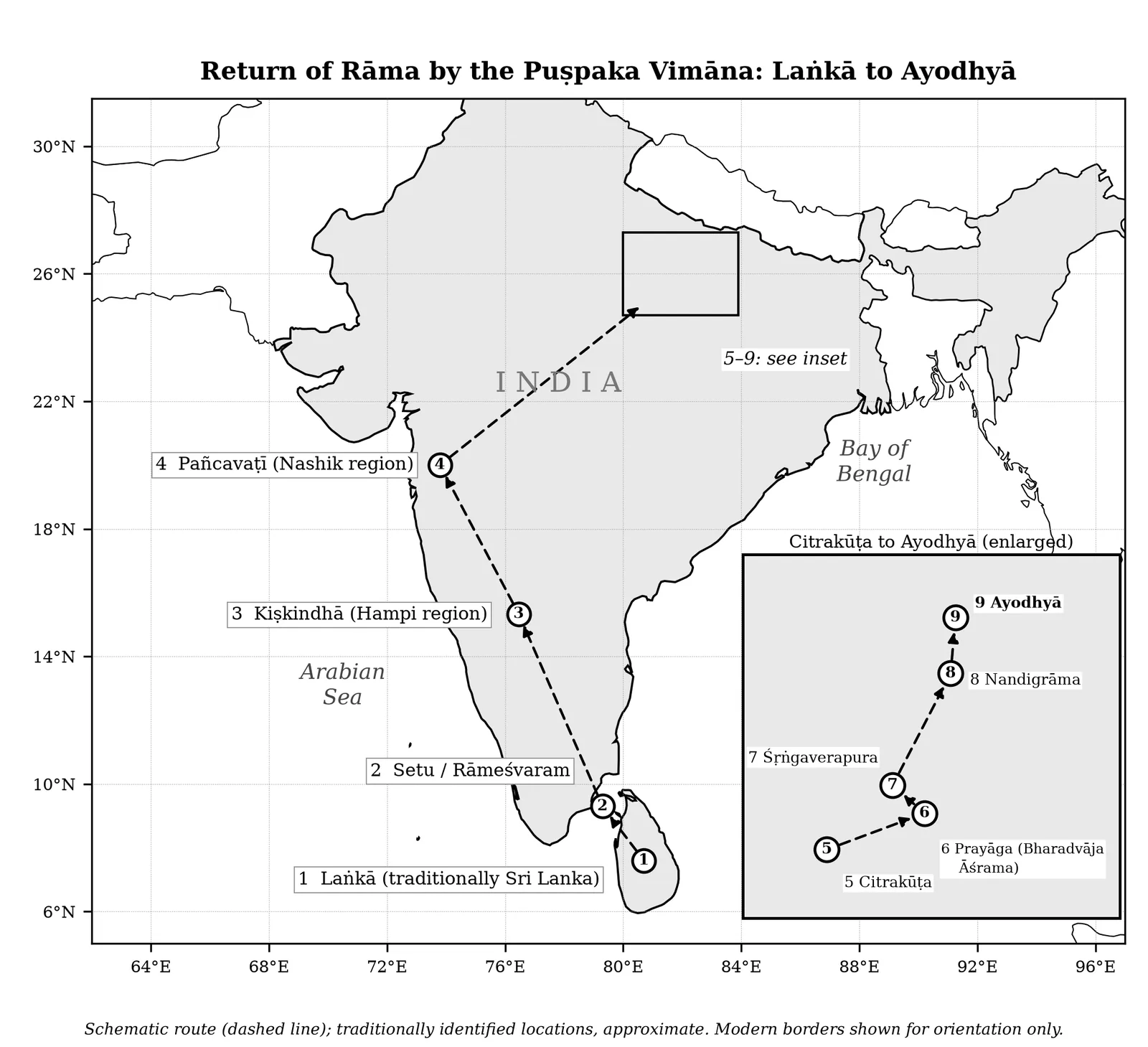
By the time this sarga opens, the long story has reached its goal. Rāma has slain Rāvaṇa in battle at Laṅkā, Sītā has been recovered, Vibhīṣaṇa has been made king of the rākṣasas, and the fourteen years of exile in the forest have run their course. Rāma, Sītā and Lakṣmaṇa have returned with their allies, the vānara chiefs and Vibhīṣaṇa, to the neighbourhood of Ayodhyā. The poem now turns from the clangour of war to the quiet work of restoration: a kingdom is to be handed back, a family is to be made whole again, and a king is to be crowned.
Bharata at Nandigrāma
The key to the feeling of the first part of the sarga is Bharata. When Rāma went to the forest, Bharata refused the throne that his mother Kaikeyī had obtained for him. He went to meet Rāma in the forest and begged him to return; Rāma, bound by his father's word, could not, and gave him his sandals, the pādukās, to be set on the throne in his place. Bharata then lived at Nandigrāma, outside the city, in the dress of an ascetic, and governed in the name of the sandals, regarding the kingdom as a trust held for his brother. In this sarga he appears again in that character, and the opening verses show him placing the kingdom in Rāma's hands and pleading with him to accept it. The sarga is therefore not only the story of a coronation, but of a great act of renunciation, which is the necessary preparation for it.
The Meaning of Paṭṭābhiṣeka
The word paṭṭābhiṣeka joins two ideas. Abhiṣeka is the sprinkling or bathing with consecrated water, the central act of the royal consecration, by which the king is made fit to rule; paṭṭa is the royal fillet or diadem, here the crown, which is bound upon the head as the sign of sovereignty. The sarga gives both, and the account is built in a particular order: the waters are fetched from the four oceans and the rivers by the vānara chiefs (verses 49–59), the priests with Vasiṣṭha at their head consecrate Rāma (60–64), and the crown, the gifts of the gods and the gifts of the king follow (65–89). The ritual is not an empty ceremony. In the Indian view the consecrated king holds the earth in trust for dharma, and the whole event is both a public occasion and a sacred rite, in which the elements, the oceans and the rivers, take part and the gods look on.
Rāma-rājya
The poem then describes the reign (verses 90–105). The age of Rāma, Rāma-rājya, is described first by what is absent: no widow's lament, no fear of beasts or of thieves, no father who must perform the funeral rites of a son; and then by what is present: joy, devotion to dharma, trees ever in flower and fruit, rain in season, and the people content in their own duties and free from greed. The tradition has made Rāma-rājya its standard of good government, but the poem's own emphasis is on the moral quality of the people: the world is good because the king is good. It is not a description of a political system so much as a picture of what happens when righteousness stands at the centre. For the devotee, there is a second sense: Rāma-rājya is the condition of the heart in which the Lord has been enthroned and the passions have been put in their place.
The Phalaśruti
The last eighteen verses (106–123) pass from narration to benediction. It is a convention of Indian religious literature that a text ends with a phalaśruti, a list of the fruits that come to those who hear, recite or copy it: freedom from sin, long life, sons, victory, safe journeys, the pleasure of the gods and the ancestors, and a dwelling in heaven. The list should be read in the spirit in which it is given. It is not a bargain but an invitation, which meets the hearer where he is, among the ordinary wishes of life, and leads him towards what the poem has been teaching throughout: that Rāma is the support of the righteous and that devotion to him is the highest gain. Many modern scholars regard the phalaśruti and some of the identifications within it, such as that of Rāma with Viṣṇu and of Lakṣmaṇa with Śeṣa, as later additions to the older body of the epic; the tradition, however, receives them as part of the sarga, and the commentary treats them accordingly, noting where a later tradition is being described.
How to Use This Book
Each verse is offered in layers. The reader who wishes simply to recite can use the Devanagari text and the phonetic transliteration; the reader who wishes to understand will find the translation and the explanation; and the reader who wishes to study each line will find the word meanings and the interpretation. The translation of each line in the detailed study is the same wording that appears in the main translation, and the word meanings use the same English words, so that the layers can be read against one another. Where the text is directly spoken by a character, the speaker is named; where it is the poet's own narration, it is marked as that. A few places where the printed text has a slip, or where readings differ, are noted briefly where they occur. The interpretations draw on the context of the poem and on the traditional commentators, and where a later tradition is being described rather than the poem itself, the commentary says so.