Explanation
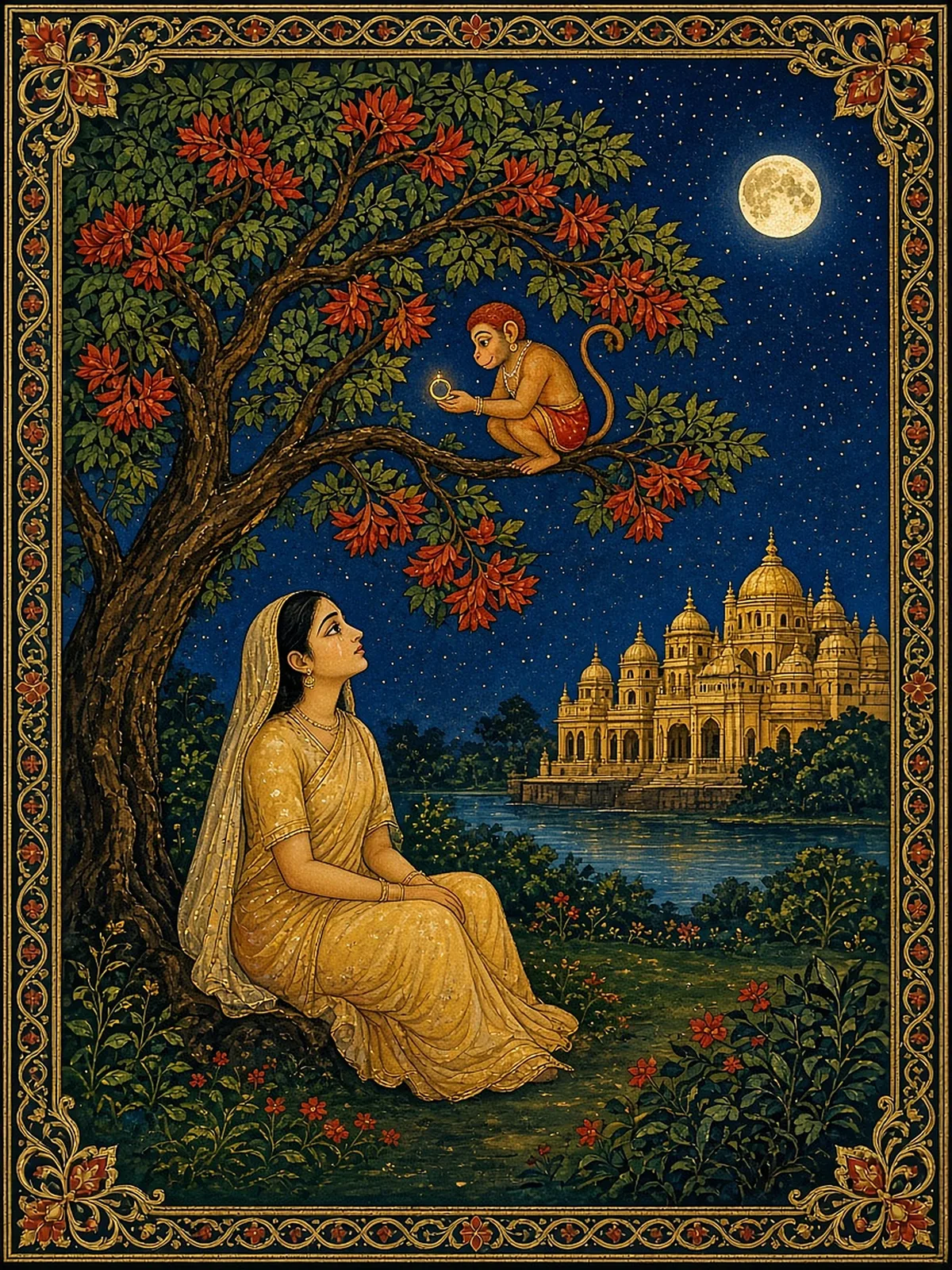
With the ninth caupāī, the Cālīsā moves from describing Hanumān’s qualities to narrating his great deeds in the Sundarakāṇḍa, the “Beautiful Book” of the Rāmāyaṇa, which tells of his journey to Laṅkā. The verse is built on a contrast: sūkṣma rūpa, a minute form, and bikaṭa rūpa, a vast and terrible form. Hanumān, endowed with the siddhis of aṇimā (becoming minute) and mahimā (becoming vast), uses each according to need. Before Sītā, the grieving mother, he becomes small and gentle so as not to frighten her; before the arrogant city of Rāvaṇa, he becomes terrible and burns it. In the Mānasa, he enters Laṅkā itself in a form the size of a mosquito (“masaka samāna rūpa kapi dharī”), remembering Rāma; in the Aśoka grove he appears to Sītā in a small form; and when the rākṣasas set his tail ablaze, he grows enormous and leaps from rooftop to rooftop, setting the golden city on fire. The devotional intent is to show that true power knows when to be small and when to be great — gentleness toward the suffering, fierceness toward evil.
Detailed Explanation
1. सूक्ष्म रूप धरि सियहिं दिखावा (sūkṣma rūpa dhari siyahiṃ dikhāvā):
“Assuming a tiny form, you appeared before Sītā.”
- सूक्ष्म (sūkṣma): Minute / subtle / tiny.
- रूप (rūpa): Form / shape.
- धरि (dhari): Having assumed / taking on (absolutive of dharanā, to hold, to assume).
- सियहिं (siyahiṃ): To Sītā (siya = Sītā, + -hiṃ, the object/dative marker).
- दिखावा (dikhāvā): Showed / revealed / made visible — “showed (yourself)” to Sītā.
Interpretation (elaborative):
Having crossed the ocean, Hanumān searched all of Laṅkā by night, from palace to palace, until he found Sītā in the Aśoka grove, emaciated, surrounded by fearsome rākṣasīs, her mind fixed on Rāma. He hid in a tree above her and witnessed Rāvaṇa’s cruel threats and her fearless refusals. When Sītā, in despair, longed for death, Hanumān, in the Mānasa, first dropped Rāma’s ring before her, and then began to sing Rāma’s virtues; when she asked who was speaking, he came before her in his small form. The small form is an act of compassion. A suffering person does not need a display of power; she needs gentleness, trust and the assurance that she is not forgotten. Hanumān made himself small so that Sītā would not fear him, and spoke sweetly, telling her of Rāma’s grief and love. It is a profound lesson in how to approach someone in pain. Sūkṣma also means subtle. Spiritually, the Divine Mother — Sītā as Śakti, as grace — is approached not through the gross ego but through subtlety, humility and refinement of mind. The ego must become small, almost invisible, before grace can be seen. Hanumān’s smallness before Sītā is the smallness of a child before its mother; indeed Sītā later blesses him as her son. Notice too that dikhāvā can mean “showed” — he showed himself, and some read it also as “showed her Rāma’s ring” or “showed her hope”. Practically, this line teaches us to be gentle with those who suffer, to make ourselves small in their presence, and to carry the message of God’s love to them in a form they can receive. It also teaches us to approach the Divine with a small ego, for only the humble can see the Mother.
2. बिकट रूप धरि लंक जरावा (bikaṭa rūpa dhari laṃka jarāvā):
“Assuming a formidable form, you set Laṅkā ablaze.”
- बिकट (bikaṭa): Formidable / terrible / enormous / awe-inspiring (Sanskrit vikaṭa).
- रूप (rūpa): Form.
- धरि (dhari): Having assumed.
- लंक (laṃka): Laṅkā — Rāvaṇa’s golden island-city.
- जरावा (jarāvā): Burned / set ablaze (from jarānā, causative of jaranā, to burn).
Interpretation (elaborative):
After comforting Sītā, Hanumān deliberately created a disturbance: he destroyed the Aśoka grove, slew the rākṣasas sent against him, including Rāvaṇa’s son Akṣayakumāra, and finally allowed himself to be bound by Indrajit’s brahmāstra so that he could meet Rāvaṇa. In the court he gave Rāvaṇa wise counsel — return Sītā, take refuge in Rāma — but Rāvaṇa, enraged, ordered his death; when Vibhīṣaṇa pointed out that a messenger may not be killed, Rāvaṇa ordered instead that his tail be set on fire. In the Mānasa, the more cloth and oil they brought, the longer the tail grew, until the city ran short of cloth and oil. Then, with his tail aflame, Hanumān became small to slip from his bonds and then vast, and leapt across the rooftops of Laṅkā, setting the golden palaces on fire — sparing only Vibhīṣaṇa’s house, and the grove where Sītā sat. Afterward he extinguished his tail in the ocean and returned to Sītā to take her leave. The bikaṭa rūpa is the form of righteous wrath. Hanumān is not cruel; he is the agent of justice, revealing to Rāvaṇa that his golden city, built on arrogance and injustice, is not invulnerable. Laṅkā may also be read symbolically as the fortress of the ego — glittering, proud, and holding the soul (Sītā) captive. Devotion first comforts the soul (the small form) and then burns down the fortress of ego (the vast form). Practically, the two lines together teach balance: be gentle with the suffering, and be uncompromising with injustice and with your own inner Laṅkā — the habits, attachments and arrogance that hold the soul captive. Ask Hanumān to set fire to them, leaving untouched only what is devoted to Rāma.