Explanation
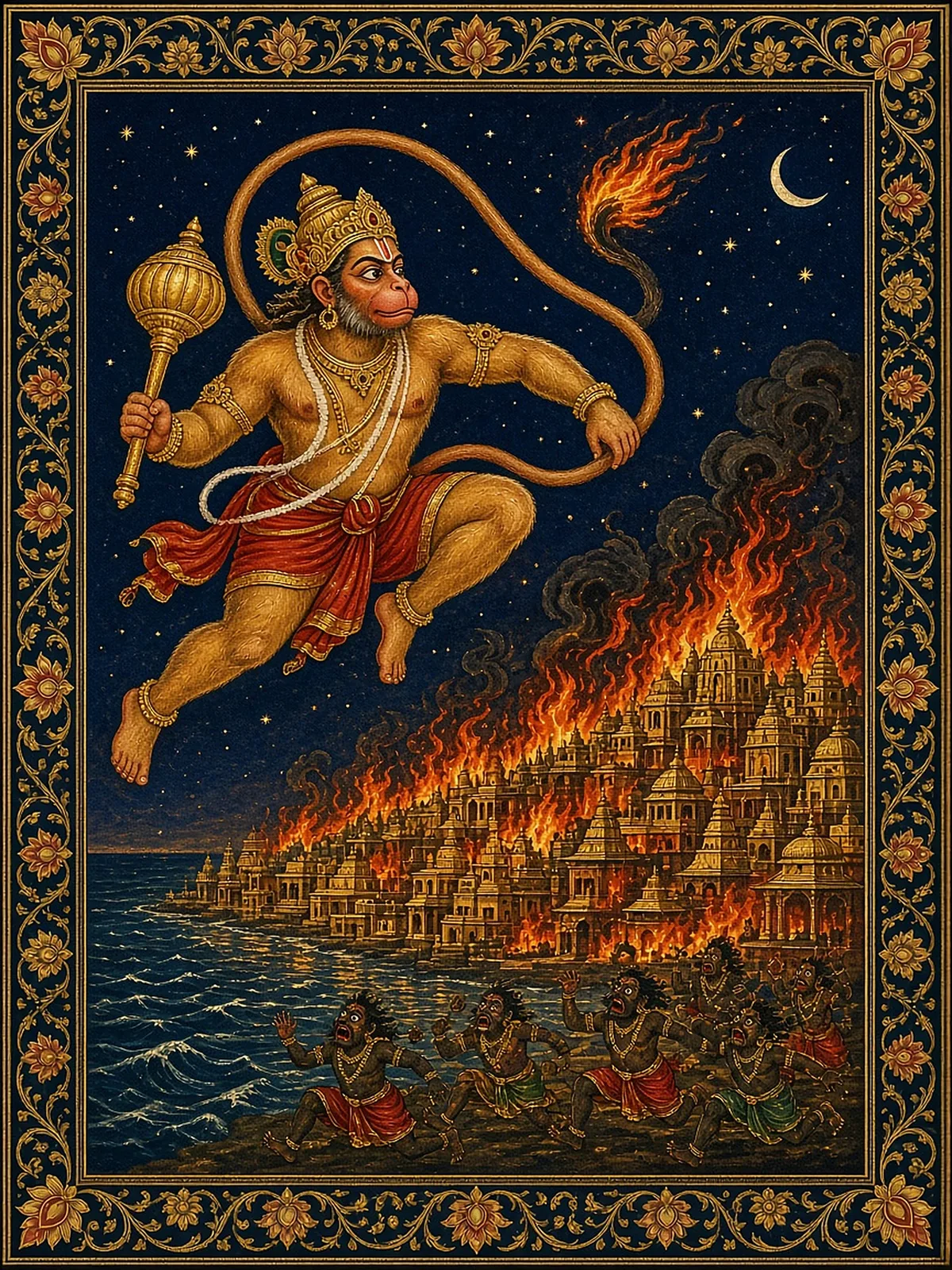
The tenth caupāī continues the narration of Hanumān’s deeds, moving from the Sundarakāṇḍa to the great war in Laṅkā described in the Yuddhakāṇḍa (called Laṅkākāṇḍa in the Mānasa). Taking a bhīma rūpa — a terrible, mighty form — Hanumān slew many asuras (here, the rākṣasa warriors of Rāvaṇa) and thereby perfected (saṃvāre) the work of Rāmacandra. In the Vālmīki Rāmāyaṇa, Hanumān kills a series of formidable rākṣasa champions in the war — among them Dhūmrākṣa, Akampana, Devāntaka, Triśiras and Nikumbha — and earlier, in Laṅkā, Akṣayakumāra and many of Rāvaṇa’s generals. Importantly, the second line repeats the refrain of Hanumān’s life: all this was for Rāma’s work. The devotional intent is to show that Hanumān’s destructive power is wholly in the service of protection and restoration — he destroys only what must be destroyed so that dharma may be re-established.
Detailed Explanation
1. भीम रूप धरि असुर संहारे (bhīma rūpa dhari asura saṃhāre):
“Assuming a dreadful form, you destroyed the demons.”
- भीम (bhīma): Dreadful / mighty / terrifying / colossal.
- रूप (rūpa): Form.
- धरि (dhari): Having assumed.
- असुर (asura): Demons — here the rākṣasa host of Rāvaṇa; in a wider sense, all forces opposed to the divine order.
- संहारे (saṃhāre): Destroyed / slew / annihilated (Sanskrit saṃhāra).
Interpretation (elaborative):
Verse 9 spoke of the bikaṭa rūpa that burned Laṅkā; verse 10 speaks of the bhīma rūpa that destroyed the asuras. The repetition of “assuming a form” (rūpa dhari) three times in two verses — subtle, formidable, dreadful — emphasises Hanumān’s mastery over his own form, and also the principle that he takes whatever form the situation and Rāma’s service require. He is not attached to any form; he is free. In the war, Hanumān was everywhere. When Rāvaṇa’s generals pressed hard on the vānara army, it was often Hanumān who turned the tide. The Vālmīki Rāmāyaṇa describes him hurling mountain peaks and trees, wrestling with giants, and slaying rākṣasa champions one after another. Even Rāvaṇa himself was staggered by a blow from Hanumān, and praised his strength. Yet the word asura invites reflection. The asuras in Indian thought are not merely external enemies; they are also the forces of selfishness, cruelty, greed and delusion within the human being. The Bhagavad Gītā (in its sixteenth chapter) describes the “āsurī sampad”, the demonic qualities — hypocrisy, arrogance, pride, anger, harshness and ignorance — as opposed to the divine qualities. Hanumān’s bhīma rūpa is invoked by the devotee to destroy these inner asuras, which are often more formidable than any external enemy. Practically, this line encourages courage in the face of evil. There are moments when gentleness is not enough, when wrongdoing must be confronted firmly. Hanumān teaches that such firmness should come not from personal hatred but from devotion to the good. The devotee may also chant this line when facing inner struggles — compulsions, rage, fear — invoking Hanumān’s mighty form to stand guard and to defeat whatever asura has seized the mind.
2. रामचंद्र के काज संवारे (rāmacaṃdra ke kāja saṃvāre):
“And accomplished the tasks of Śrī Rāmacandra.”
- रामचंद्र (rāmacaṃdra): Śrī Rāmacandra — Rāma, “Rāma the moon”, gentle and cooling like the moon.
- के (ke): Of.
- काज (kāja): Works / tasks / purposes.
- संवारे (saṃvāre): Accomplished / perfected / set in order / adorned — from saṃvāranā, to arrange beautifully, to set right.
Interpretation (elaborative):
It is significant that the poet here uses the name Rāmacandra, “Rāma the Moon”. In the midst of describing Hanumān’s terrible form and the slaughter of demons, he reminds us of the moon-like coolness, gentleness and beauty of the Lord for whom all this was done. The fierce deeds of the servant serve the gentle purpose of the Master: the restoration of Sītā, the protection of the good, the establishment of a righteous kingdom. The verb saṃvāre is beautiful and subtle. It does not mean merely “completed” or “finished”, but “set in perfect order, arranged gracefully, adorned”. Hanumān did not just get Rāma’s work done; he did it beautifully, perfectly, leaving nothing undone or done badly. This is the mark of a great servant: excellence in service, not mere completion. In the Mānasa, when Hanumān returned from Laṅkā with news of Sītā, Rāma was so moved that he said no one in heaven or earth could be as great a benefactor to him, and that he could never repay the debt. Hanumān’s response was to fall at Rāma’s feet, overwhelmed, praying only for unwavering devotion. Practically, this verse teaches excellence and dedication in all we do. Whatever task falls to us — at home, at work, in service — can be done as Rāma’s work, with care and beauty, not grudgingly or carelessly. The word saṃvāre invites us to adorn our duties with love. And when we succeed, we may remember that it was Rāmacandra’s work, not ours, and offer the credit to Him, as Hanumān always did.