Explanation
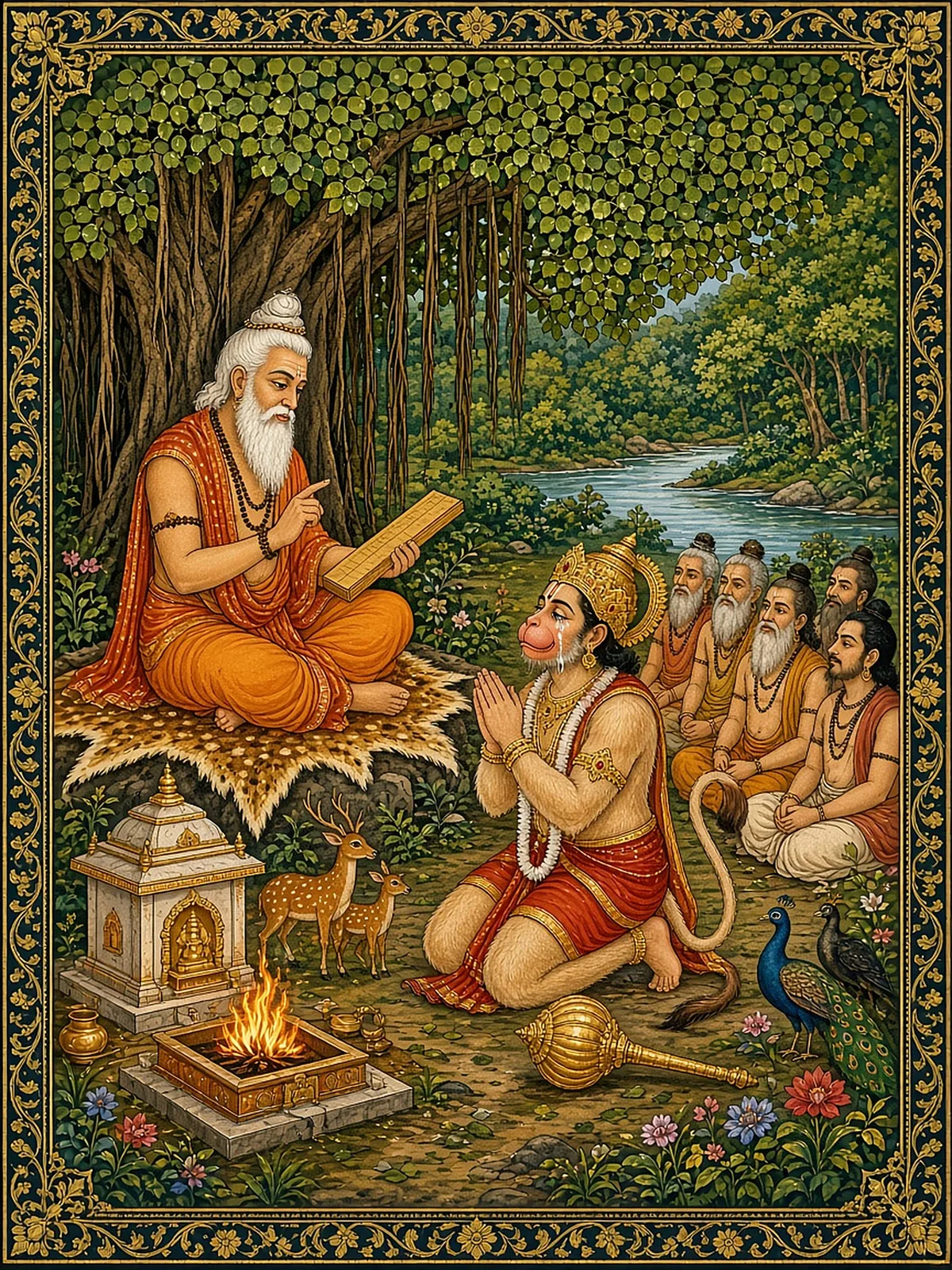
The previous verse showed Hanumān as eager to do Rāma’s work; this verse shows him as one who delights to hear Rāma’s story. Action and contemplation, service and listening, are perfectly balanced in him. He is a rasiyā — a connoisseur, a relisher — of prabhu caritra, the deeds of the Lord. And the result of such loving listening is that Rāma, Lakṣmaṇa and Sītā take up residence in his heart. A popular devotional image — echoed in later stories — shows Hanumān tearing open his chest to reveal Sītā-Rāma seated within, a vivid picture of this line. A celebrated traditional Sanskrit verse also declares that wherever the glory of Raghunātha is sung, there Mārutī is present, with head bowed, palms joined, and eyes full of tears: “yatra yatra raghunāthakīrtanaṃ tatra tatra kṛtamastakāñjalim, bāṣpavāriparipūrṇalocanaṃ mārutiṃ namata rākṣasāntakam”. The devotional intent is to teach that śravaṇa — devoted listening — is the gateway through which the Lord enters the heart.
Detailed Explanation
1. प्रभु चरित्र सुनिबे को रसिया (prabhu caritra sunibe ko rasiyā):
“You delight in hearing the story of the Lord.”
- प्रभु (prabhu): The Lord / Master — here Śrī Rāma.
- चरित्र (caritra): Deeds / story / conduct / life-narrative — the Rāma-kathā.
- सुनिबे (sunibe): To hear / for hearing — Awadhi infinitive of sunanā.
- को (ko): For / to.
- रसिया (rasiyā): Relisher / connoisseur / lover — one who tastes the rasa, the sweet essence, of something.
Interpretation (elaborative):
The word rasiyā comes from rasa, a central idea in Indian aesthetics and devotion: the essence, flavour or delight experienced in poetry, music and love. A rasiyā is one who does not merely hear but savours. Many people hear the story of Rāma; few taste it. Hanumān tastes it every time as if for the first time, and never tires. In the Mānasa, the story of Rāma is called a holy lake (mānasa) whose waters purify and refresh all who bathe in it. Hanumān is the swan who lives on that lake. Śravaṇa, hearing the Lord’s glories, is the first of the nine forms of devotion listed in the Bhāgavata Purāṇa (śravaṇaṃ kīrtanaṃ viṣṇoḥ smaraṇaṃ…), and it is foundational because what we hear shapes what we think, and what we think shapes what we become. Even Hanumān’s own role in the story begins with this kind of listening: in Laṅkā, he introduces himself to Sītā not by appearing suddenly, but by narrating Rāma’s story softly from the tree, and Sītā’s heart opens as she hears it. The power of Rāma-kathā to awaken faith is something Hanumān knows intimately. Devotional tradition holds that Hanumān, as a cirañjīvī, is present wherever the Rāmāyaṇa is recited, and many reciters keep an empty seat or offer a special place for him. In the Uttarakāṇḍa of the Vālmīki Rāmāyaṇa, Hanumān asks Rāma that his life may last as long as Rāma’s story is told on earth — he wishes to live only to hear it. Practically, this line invites us to make a habit of listening to or reading sacred stories, not as an obligation, but with relish, letting their beauty enter the heart. Even a few verses heard daily with attention can transform the inner landscape.
2. राम लखन सीता मन बसिया (rāma lakhana sītā mana basiyā):
“Śrī Rāma, Lakṣmaṇa and Sītā dwell in your heart.”
- राम (rāma): Śrī Rāma.
- लखन (lakhana): Lakṣmaṇa (Awadhi form Lakhana) — Rāma’s devoted younger brother.
- सीता (sītā): Sītā — Rāma’s consort, daughter of Janaka, the embodiment of purity and devotion.
- मन (mana): Mind / heart.
- बसिया (basiyā): Dweller / one who dwells (from basanā, to dwell, Sanskrit vas); the phrase can be read “in whose heart Rāma, Lakṣmaṇa and Sītā dwell”, or “who dwells in the hearts of Rāma, Lakṣmaṇa and Sītā”.
Interpretation (elaborative):
This line beautifully allows two readings, both true. The more common reading is that Rāma, Lakṣmaṇa and Sītā dwell in Hanumān’s heart: having heard their story with such love, he has given them a permanent home within. The other reading, also accepted by many commentators, is that Hanumān dwells in the hearts of Rāma, Lakṣmaṇa and Sītā — he is so dear to them that he lives in their minds. Love in true bhakti is mutual: the devotee holds the Lord in his heart, and the Lord holds the devotee in His. Why are three named and not Rāma alone? Because Hanumān’s devotion includes the whole divine family. He served Sītā with a son’s tenderness, calling her Mother; he saved Lakṣmaṇa’s life; and he is Rāma’s dearest servant. The trio also represent in tradition a spiritual unity: Rāma as the Supreme, Sītā as His inseparable grace and power, Lakṣmaṇa as the perfect devotee or the guardian of the path. The heart in which all three dwell is complete. This line also connects to the closing dohā of the Cālīsā, where the devotee prays to Hanumān to dwell in his heart together with Rāma, Lakṣmaṇa and Sītā. The hymn thus asks that what is true of Hanumān’s heart become true of ours. The practical teaching is gentle but profound: what we listen to, we come to love; what we love, comes to live in us. If we fill our ears with gossip, anxiety and complaint, those take up residence in the heart. If we fill them with the story of Rāma, the heart becomes Ayodhyā. Many devotees take this verse as an invitation to keep a small inner shrine: at quiet moments in the day, they picture Sītā-Rāma with Lakṣmaṇa seated within the heart, and Hanumān at their feet.