Explanation
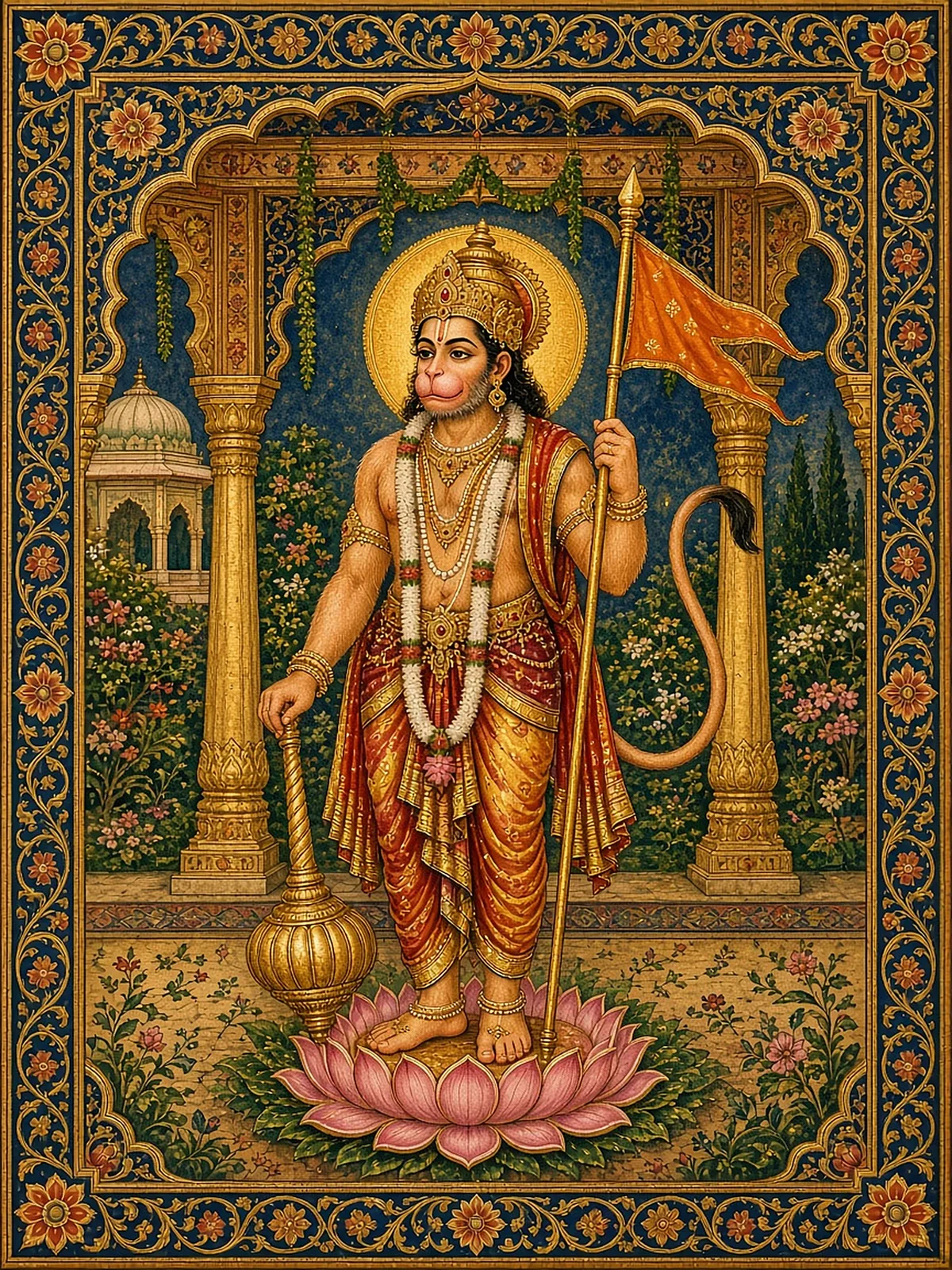
After praising Hanumān’s wisdom, strength and heroism, the poet now offers a loving description of his form, which the devotee can hold in meditation (dhyāna). Hanumān has a golden complexion (kaṃcana barana), radiant and auspicious; he is beautifully dressed (subesā); he wears kuṇḍalas, earrings, in his ears; and his hair is curly (kuṃcita kesā). This description belongs to the tradition of rūpa-dhyāna, the meditation on the divine form, which runs through Indian devotional poetry from the Purāṇas to the saint-poets. The golden colour recalls Tulasīdāsa’s own Sanskrit invocation in the Sundarakāṇḍa, where Hanumān is called “hemaśailābhadeham”, “one whose body shines like a golden mountain” — a description that also echoes the scene in which Hanumān reveals his vast golden form to Sītā to reassure her that a small monkey can indeed defeat the rākṣasas. The devotional intent of this verse is to make Hanumān present before the inner eye, so that the one who chants does not merely think about him but beholds him.
Detailed Explanation
1. कंचन बरन बिराज सुबेसा (kaṃcana barana birāja subesā):
“Golden is your complexion, and you shine in beautiful attire.”
- कंचन (kaṃcana): Gold (Sanskrit kāñcana) — symbol of purity, radiance, value and incorruptibility.
- बरन (barana): Complexion / colour (Sanskrit varṇa).
- बिराज (birāja): Shining / resplendent / gracefully present (Sanskrit virāj, to shine, to be eminent).
- सुबेसा (subesā): Beautifully attired / well-dressed / of handsome appearance — su (good, beautiful) + besa (Sanskrit veṣa, dress, appearance).
Interpretation (elaborative):
Gold is the metal that does not tarnish. Fire does not destroy it; fire only purifies it. Hanumān’s golden colour therefore points to an inner quality: he has passed through every fire — the fire of the ocean leap, the fire of battle, even the literal fire set to his tail in Laṅkā — and emerged only brighter. When the rākṣasas wrapped his tail in oil-soaked cloth and set it ablaze, the fire did not burn him; in the Rāmāyaṇa accounts, Sītā prays to Agni to be cool to him, and he feels the flame as cool while it consumes Laṅkā. Like gold, Hanumān is tested and found pure. In the Sundarakāṇḍa of the Mānasa, when Sītā doubts how small monkeys can defeat the mighty rākṣasas, Hanumān reveals his true form — “kanaka bhūdharākāra sarīrā”, a body like a golden mountain, terrifying in battle, immensely strong — and then at once becomes small again. The golden form is thus both beautiful and reassuring. Birāja suggests effortless radiance — he does not strive to shine; he simply shines, as the sun does. Subesā, beautifully attired, may surprise those who imagine a monkey-warrior in rough form. Yet the tradition imagines Hanumān with dignity and grace, wearing a loincloth, the sacred thread, ornaments given in love — later stories even tell of a necklace of pearls given by Sītā. In a deeper sense, his finest garment is his humility and his devotion. Practically, this line invites the devotee to begin meditation by visualising Hanumān’s golden radiance filling the heart, dispelling the darkness of fear and dullness. It also offers a quiet teaching: let your own life be like gold — tested by difficulties, yet growing purer rather than bitter.
2. कानन कुंडल कुंचित केसा (kānana kuṃḍala kuṃcita kesā):
“Earrings adorn your ears, and your hair is curly.”
- कानन (kānana): In the ears — kāna (ear, Sanskrit karṇa) + -na, the Awadhi oblique plural, with the locative postposition understood (“in the ears”). Not the Sanskrit kānana, “forest”.
- कुंडल (kuṃḍala): Earrings — ring-shaped ornaments worn in the ears, traditionally worn by heroes, sages and deities.
- कुंचित (kuṃcita): Curled / curly / wavy (Sanskrit kuñcita).
- केसा (kesā): Hair (Sanskrit keśa).
Interpretation (elaborative):
The description moves from the whole form to its details — the ears and the hair — as a devotee’s gaze moves lovingly from the overall radiance to the particulars. The kuṇḍalas are among the ornaments associated with heroes and divinities; Śiva and Viṣṇu are both described with shining earrings, and great yogis often wear them as signs of initiation. Their mention here reminds us that Hanumān is not an ordinary monkey but a divine being, adorned as gods are. Some devotees also connect the earrings to the ears themselves: Hanumān’s ears are ever turned toward the story of Rāma, as verse 8 will declare — he is “prabhu caritra sunibe ko rasiyā”, a lover of hearing his Lord’s deeds. Ears that listen to the divine are the truly adorned ears. Kuṃcita kesā, curly hair, adds a touch of tender beauty. In Indian poetry curly hair is a mark of youth and charm; Kṛṣṇa and Rāma are often described with curling locks. Applied to Hanumān, it suggests youthful vigour — he is ever young, ever fresh in service. Why should a hymn about strength and protection pause to describe earrings and hair? Because bhakti is a relationship of love, and love delights in details. A mother remembers the curls of her child; a devotee remembers the ornaments of the beloved deity. Tulasīdāsa teaches us to approach Hanumān not only as a powerful protector to be feared and petitioned, but as a beautiful presence to be loved. Practically, many devotees use this verse as the starting point of a short meditation: closing the eyes, they picture the golden form, the earrings catching the light, the curly hair, the gentle face looking with compassion — and rest the mind there for a few breaths before continuing the recitation. This transforms chanting from mere words into a living encounter.