Explanation
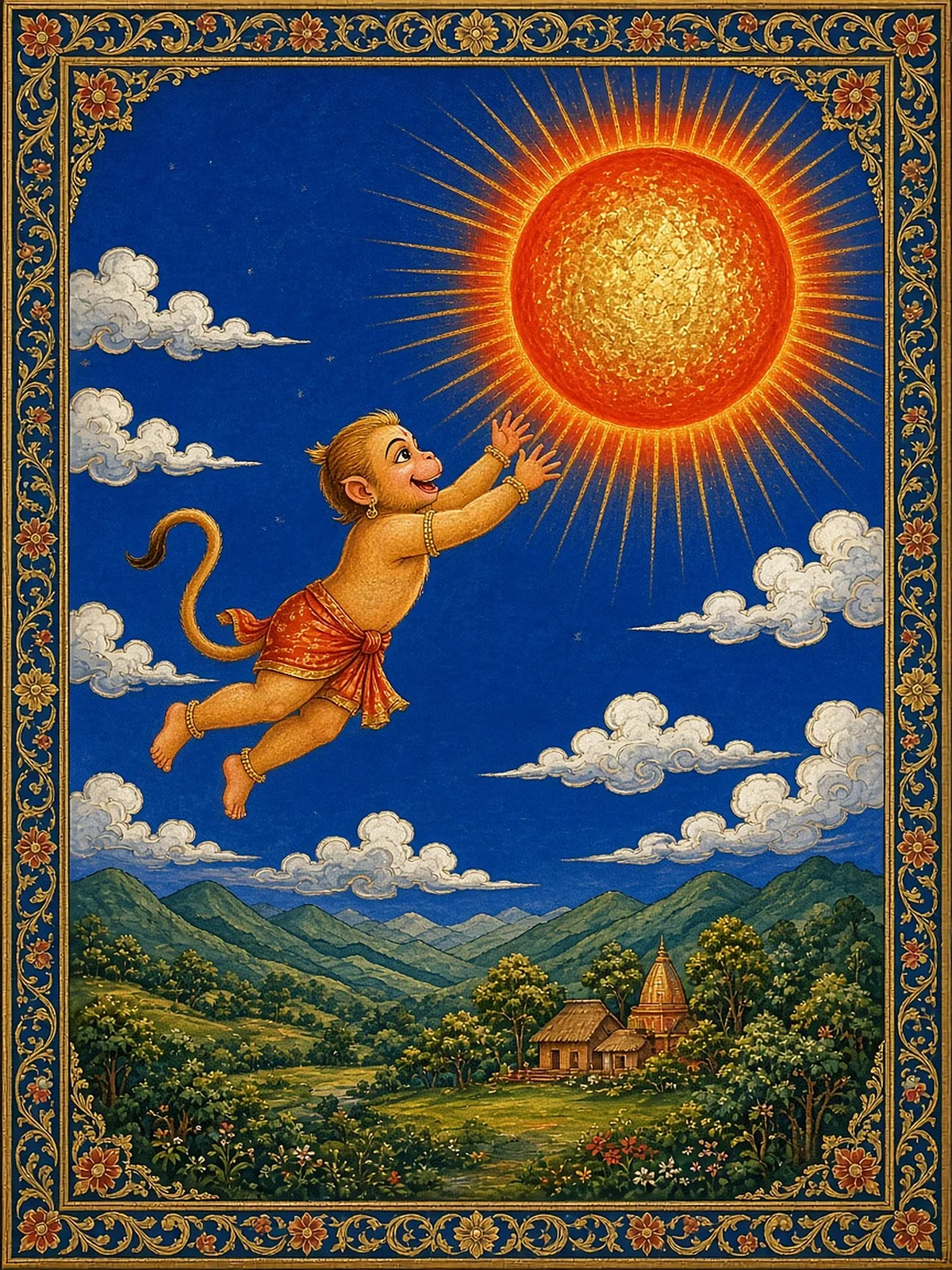
This caupāī recalls the most famous story of Hanumān’s childhood. According to the Vālmīki Rāmāyaṇa (narrated in the Kiṣkindhākāṇḍa by Jāmbavān and at greater length in the Uttarakāṇḍa by Agastya), the infant Hanumān, seeing the rising sun, took it for a ripe fruit and leapt into the sky to seize it. The poet says the sun is juga sahasra jojana para — at a distance of “yuga sahasra yojanas” — and that Hanumān “swallowed” it, thinking it a sweet fruit. The traditional accounts go on to describe how Indra struck the child with his vajra on the jaw, and how Vāyu’s grief and the gods’ blessings followed. The phrase juga sahasra jojana has attracted much modern attention: some readers multiply a yuga (taken as 12,000 years) by sahasra (1,000) by a yojana (taken as about 8 miles) to arrive at a figure close to the actual distance between the earth and the sun. This is a popular modern interpretation, not one stated by Tulasīdāsa or the traditional commentators, and the values of yuga and yojana vary across texts; it is best understood as an interesting reflection rather than a claim of the poem. The devotional intent is to show the boundless power and innocent joy of Hanumān even as a child.
Detailed Explanation
1. जुग सहस्र जोजन पर भानू (juga sahasra jojana para bhānū):
“The sun, which is yuga-sahasra yojanas away…”
- जुग (juga): Yuga (an age) — but the Hindī Śabdasāgara also records juga = “pair, two” (do, ubhaya) (Sanskrit yugma). The Mahāvīrī commentary takes juga sahasra loosely as “many thousands”; others read “two thousand” or “a yuga of thousands”. The text itself does not fix a number.
- सहस्र (sahasra): Thousand.
- जोजन (jojana): Yojana — an ancient unit of distance (the Śabdasāgara gives jojana simply as the vernacular form of yojana). It is commonly reckoned at four kos (about eight miles), though texts differ on its exact value.
- पर (para): At (the distance of) / beyond / far off.
- भानू (bhānū): The sun (Sanskrit bhānu, “the radiant one”).
Interpretation (elaborative):
The first line establishes the immense distance of the sun, to make the child’s feat all the more astonishing. Whether we take juga sahasra jojana as a precise calculation or as poetic hyperbole — “thousands upon thousands of leagues” — the point is that the sun is unimaginably far, and the infant Hanumān reached it in a single leap. On the popular calculation mentioned above, a yuga of 12,000 (divine) years multiplied by a thousand and by a yojana of about eight miles gives roughly 96 million miles, close to the modern figure of about 93 million miles. This coincidence has delighted many readers. However, it should be held lightly: classical texts give various values for yuga and yojana, the poem does not present a calculation, and the faith of the Cālīsā does not depend on it. The sun itself is a deeply meaningful symbol. In the Vedas the sun is the visible form of the Divine light, the eye of the world, the giver of life, and the object of the Gāyatrī mantra. That the infant Hanumān leaps toward the sun suggests the innate longing of the pure soul for the light. Tradition also says that Hanumān later became the disciple of Sūrya, learning the scriptures from him — so the child who once tried to swallow the sun as a fruit later received from it the fruit of knowledge. Practically, this line encourages boldness of aspiration. However distant the goal — knowledge, virtue, God — the one who has Hanumān’s faith does not calculate the distance but leaps. It also reminds us that the soul in its innocence reaches naturally for the light. It should be said plainly that the words themselves do not fix such a number: juga can mean “age” or “pair”, and the Mahāvīrī commentary simply takes juga sahasra jojana as “many thousands of yojanas”. The verse’s purpose is wonder, not astronomy.
2. लील्यो ताहि मधुर फल जानू (līlyo tāhi madhura phala jānū):
“You swallowed it, taking it to be a sweet fruit.”
- लील्यो (līlyo): Swallowed / gulped (from līlanā, to swallow).
- ताहि (tāhi): That / it — referring to the sun.
- मधुर (madhura): Sweet.
- फल (phala): Fruit.
- जानू (jānū): Knowing / taking (it) to be / thinking (it).
Interpretation (elaborative):
The story, as related in the Vālmīki Rāmāyaṇa’s Uttarakāṇḍa, is full of childlike charm. Hanumān, hungry, saw the rising sun, red like a ripe fruit, and leapt for it. The Sun-god, it is said, did not burn him, knowing he was a child destined for great things. On that day Rāhu, the eclipse-demon, was approaching to seize the sun, and found a child there before him; he complained to Indra, who came on his elephant Airāvata. When Hanumān turned toward Rāhu and then toward Airāvata as another fruit, Indra hurled his vajra, striking the child on the jaw (hanu), and he fell to earth. Vāyu, enraged, withdrew into a cave with his son, and all beings began to suffocate. Brahmā came, revived the child with his touch, and the gods granted boons. In the Cālīsā, Tulasīdāsa says simply līlyo — “swallowed” — capturing the popular tradition in which the child actually takes the sun into his mouth, plunging the world into darkness until he releases it. The phrase madhura phala jānū — “thinking it a sweet fruit” — is full of tenderness. The mightiest being in the universe is, at heart, an innocent child. This innocence is part of Hanumān’s charm and of his spiritual greatness: he never loses the simplicity of a child, even when he becomes the greatest of heroes and scholars. Spiritually, some interpret the sun as the radiance of knowledge, which Hanumān “swallows” — fully assimilates — as easily as a child eats fruit. Practically, this line encourages us to approach spiritual life with childlike eagerness and joy, to taste divine truth as a sweet fruit rather than a burden. It also comforts parents and children alike, presenting Hanumān as a playful, loving child-god who understands the hearts of the young.