Explanation
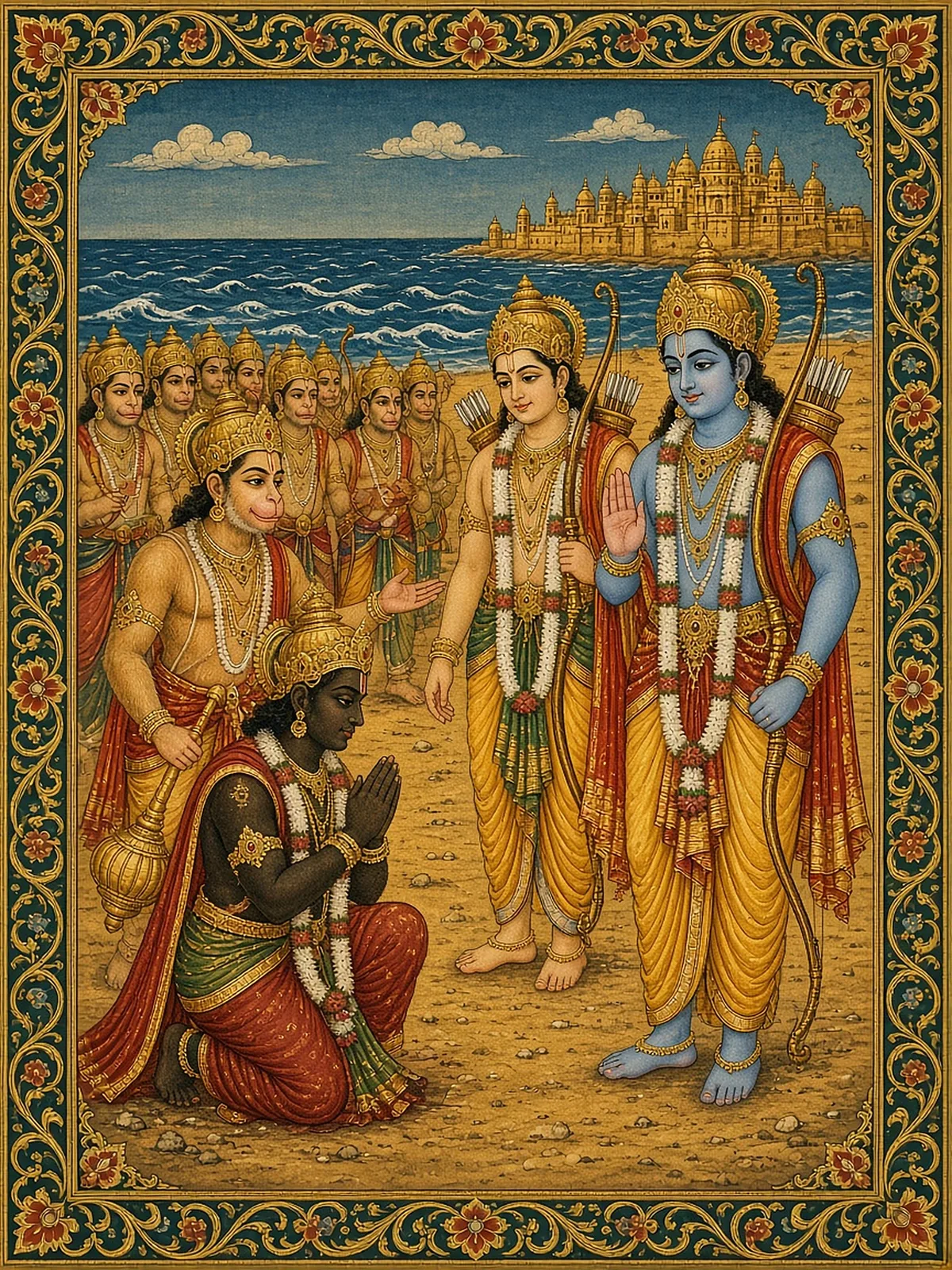
The seventeenth caupāī parallels the sixteenth. Just as Hanumān brought Sugrīva to Rāma and thereby to the throne of Kiṣkindhā, he guided Vibhīṣaṇa, the righteous younger brother of Rāvaṇa, toward Rāma, and thereby to the throne of Laṅkā. In the Mānasa’s Sundarakāṇḍa, while searching Laṅkā, Hanumān comes upon a house marked with the name of Rāma and the sacred tulasī plant, and hears its owner waking with the name of Rāma on his lips. It is Vibhīṣaṇa. Hanumān, in the guise of a brāhmaṇa, speaks with him; the two devotees recognise each other; Hanumān encourages him with the assurance of Rāma’s grace, and Vibhīṣaṇa tells him how to find Sītā. Later, when Vibhīṣaṇa is kicked out of the court by Rāvaṇa for advising the return of Sītā, he goes to Rāma for refuge; and in the Vālmīki Rāmāyaṇa, when the vānara leaders debate whether to accept this brother of the enemy, it is Hanumān’s counsel to accept him that supports Rāma’s own decision. Rāma crowns him King of Laṅkā even before the war. The devotional intent is to show that Hanumān’s mantra — his counsel and his sacred guidance — leads the righteous to the Lord and to their rightful place.
Detailed Explanation
1. तुम्हरो मन्त्र बिभीषन माना (tumharo mantra bibhīṣana mānā):
“Vibhīṣaṇa heeded your counsel.”
- तुम्हरो (tumharo): Your.
- मन्त्र (mantra): Counsel / advice / sacred instruction — mantra means both political counsel and a sacred formula or teaching.
- बिभीषन (bibhīṣana): Vibhīṣaṇa — the righteous brother of Rāvaṇa, a devotee of Rāma.
- माना (mānā): Accepted / heeded / honoured / followed.
Interpretation (elaborative):
The word mantra is rich with meaning. In politics and statecraft, mantra means counsel, deliberation, advice; ministers are called mantrīs. In spiritual life, a mantra is a sacred formula that protects the mind (traditionally explained as “that which protects (trā) the one who reflects (man)”). Hanumān’s mantra to Vibhīṣaṇa was both: practical advice and sacred guidance. In the Mānasa, Vibhīṣaṇa confides to Hanumān that he lives among the rākṣasas like the tongue among the teeth, and wonders whether Rāma would ever show grace to one like him, born in a demon family. Hanumān replies that Rāma always shows love to His servants, and points to himself: “What noble birth do I have? I am a fickle monkey, low in every way; yet even on me the Lord has shown grace.” This humble self-description encourages Vibhīṣaṇa to believe that Rāma will accept him. That was Hanumān’s mantra: do not doubt the Lord’s grace because of your birth or circumstances. Vibhīṣaṇa mānā — accepted and followed this counsel. Many hear good advice; few follow it. Rāvaṇa too heard Hanumān’s counsel in the royal court and rejected it, and was destroyed. Vibhīṣaṇa accepted it, and was raised to the throne. The difference between them lies not in the advice but in the response. Practically, this verse encourages us to listen to the mantra of the wise — the guidance of saints, scriptures and our own conscience — and to follow it, even when it requires courage. Vibhīṣaṇa had to leave his home, his brother and his security to go to Rāma. Following good counsel may cost something, but it leads to the highest gain.
2. लंकेस्वर भये सब जग जाना (laṃkesvara bhaye saba jaga jānā):
“He became the Lord of Laṅkā — the whole world knows this.”
- लंकेस्वर (laṃkesvara): Lord of Laṅkā (Sanskrit laṅkeśvara) — laṃkā + īsvara (lord).
- भये (bhaye): Became.
- सब (saba): All / whole.
- जग (jaga): World.
- जाना (jānā): Knows / knew — “is known to”.
Interpretation (elaborative):
Vibhīṣaṇa came to Rāma as a refugee, with nothing — expelled, insulted, homeless. Sugrīva and others suspected him of being a spy. But Rāma proclaimed his famous vow of refuge: whoever comes to Him even once, saying “I am Yours”, He grants fearlessness to all beings — this is His vow. In the Vālmīki Rāmāyaṇa this is the celebrated declaration “sakṛd eva prapannāya tavāsmīti ca yācate, abhayaṃ sarvabhūtebhyo dadāmy etad vrataṃ mama”. Rāma then did something remarkable: before the war had even begun, while Rāvaṇa still sat on the throne, Rāma had Vibhīṣaṇa anointed with sea-water as King of Laṅkā. In the Mānasa, Tulasīdāsa observes that the wealth Śiva granted Rāvaṇa after he offered his ten heads, Rāma gave to Vibhīṣaṇa with great hesitation, as though it were too little. After Rāvaṇa’s death, Vibhīṣaṇa was formally crowned. Tradition counts him, too, among the cirañjīvīs. Saba jaga jānā — the whole world knows. The story of Vibhīṣaṇa became the classic illustration of śaraṇāgati, total surrender, and of Rāma’s unconditional acceptance of the one who takes refuge. Generations of devotees have drawn courage from it. The anointing before the battle is also a lesson in the certainty of Rāma’s word: He treated His promise as already fulfilled, even while the outcome, to worldly eyes, was still undecided. Practically, this line offers hope to anyone who feels trapped by birth, family or past: Vibhīṣaṇa was born a rākṣasa and lived in Rāvaṇa’s city, yet he became a king and a revered devotee. It also shows the power of a single good counsellor: one conversation with Hanumān changed Vibhīṣaṇa’s destiny. May we find such counsel, and may we give it.