Explanation
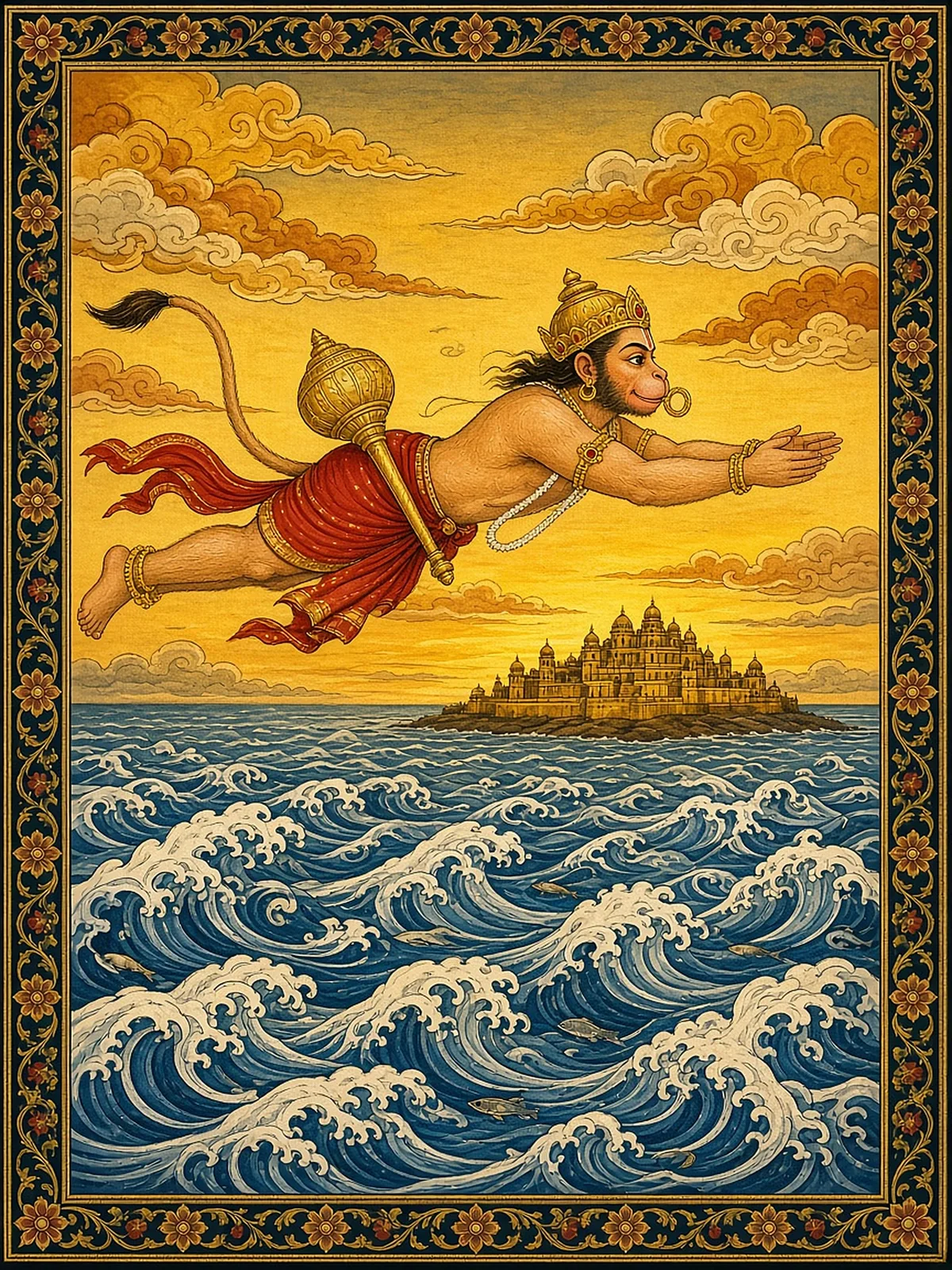
This caupāī describes Hanumān’s greatest feat in the Sundarakāṇḍa: the leap across the ocean to Laṅkā. Before the search parties set out, Rāma gave Hanumān His signet ring (mudrikā) to show to Sītā as a token, so that she would recognise him as Rāma’s genuine messenger. In the Mānasa, Rāma touches Hanumān’s head with His lotus-hand and gives the ring, knowing him to be His own servant (“parasā sīsa saroruha pānī, karamudrikā dīnhi jana jānī”). The Cālīsā says that Hanumān placed the ring in his mouth and crossed the ocean, adding the delightful phrase acaraja nāṃhīṃ — “there is no wonder in that”. Why is it no wonder? Because one who carries the Lord’s ring — the Lord’s name, the Lord’s token, the Lord’s grace — can cross any ocean. The devotional intent is to teach that the power to cross the “ocean of worldly existence” (bhavasāgara) comes from holding the Lord’s name, and that for such a one even the greatest obstacles are easily overcome.
Detailed Explanation
1. प्रभु मुद्रिका मेलि मुख माहीं (prabhu mudrikā meli mukha māhīṃ):
“Placing the Lord’s ring in your mouth…”
- प्रभु (prabhu): The Lord — Śrī Rāma.
- मुद्रिका (mudrikā): Ring / signet ring — inscribed, in tradition, with the name of Rāma.
- मेलि (meli): Having placed / putting (absolutive in -i of melanā; the Hindī Śabdasāgara gives “to put, to place”, and the Mahāvīrī commentary glosses meli as ḍālakara, “having put in”).
- मुख (mukha): Mouth.
- माहीं (māhīṃ): In / within.
Interpretation (elaborative):
The ring is a token of identity and authority. In the Vālmīki Rāmāyaṇa, Rāma gives it specifically to Hanumān, because He has confidence that Hanumān will succeed — though the southern party includes Aṅgada, the crown prince, and the wise Jāmbavān. Rāma recognises Hanumān’s special capacity. The tradition holds that the ring bore Rāma’s name, and in the Sundarakāṇḍa of the Mānasa, when the ring falls before Sītā, she sees it is inscribed with Rāma’s name and is filled with wonder and longing. Why in the mouth? Poetically, because Hanumān, flying across the ocean, needed his hands free; and because the mouth is the safest place to keep something precious when one is a vānara in flight. Spiritually, however, the meaning is beautiful: to keep the Lord’s token in the mouth is to keep the Lord’s name on the tongue. The Mānasa says that the name of Rāma placed on the threshold of the tongue is like a lamp placed at a doorway, illuminating both inside and outside. With Rāma’s name in his mouth, Hanumān crossed the ocean. The ring is also a circle, without beginning or end, a symbol of the infinite and of an unbreakable bond. Rāma entrusted His bond with Sītā to Hanumān, and Hanumān carried it faithfully. Practically, this line teaches that we too can carry the Lord’s token through the challenges of life — by keeping His name on our lips. Many devotees repeat “Rāma” or “Sītārāma” silently during difficult tasks. It also teaches faithfulness in what is entrusted to us: Hanumān guarded the ring as his most precious possession.
2. जलधि लांघि गये अचरज नांहीं (jaladhi lāṃghi gaye acaraja nāṃhīṃ):
“…you leapt across the ocean — no wonder in that!”
- जलधि (jaladhi): Ocean — literally “the holder (dhi) of waters (jala)”.
- लांघि (lāṃghi): Having leapt across / crossed over (from lāṃghanā, Sanskrit laṅghana).
- गये (gaye): Went.
- अचरज (acaraja): Wonder / surprise / astonishment (Sanskrit āścarya).
- नांहीं (nāṃhīṃ): Not / there is no.
Interpretation (elaborative):
The ocean crossing is the heart of the Sundarakāṇḍa. At the shore, the vānaras despaired; none could leap a hundred yojanas. Jāmbavān reminded Hanumān of his forgotten powers, and Hanumān, growing to the size of a mountain, sprang from Mount Mahendra. On the way he met three tests: Maināka, the golden mountain rising to offer him rest (the test of comfort); Surasā, the mother of serpents sent by the gods to test his strength and wisdom; and Siṃhikā, the shadow-seizing demoness who caught creatures by their shadows, whom he slew. He overcame all three and landed on the peak overlooking Laṅkā. The poet’s remark, acaraja nāṃhīṃ, is both playful and profound. Playful, because the whole world marvels at this leap, and the poet says, “What is so wonderful about it?” Profound, because it gives the reason: he had the Lord’s ring in his mouth. For one who carries Rāma’s name, crossing an ocean is natural. Indeed, devotional tradition adds a beautiful twist: Rāma needed a bridge to cross the ocean, while Hanumān, carrying Rāma’s name, needed none — the Name is even more powerful than its bearer. Folk tradition tells that the stones of the bridge floated because Rāma’s name was written on them. Spiritually, the ocean is bhavasāgara, the ocean of worldly existence, with its endless waves of birth and death, pleasure and pain. The Mānasa and the whole bhakti tradition declare that the name of Rāma is the boat, or the bridge, by which this ocean is crossed. Practically, this line gives courage before daunting tasks. With the Lord’s name in our mouth and His trust in our heart, we can attempt what seems impossible — and, having succeeded, we can say with Hanumān, “There is no wonder in this; it was His ring that carried me.”