Explanation
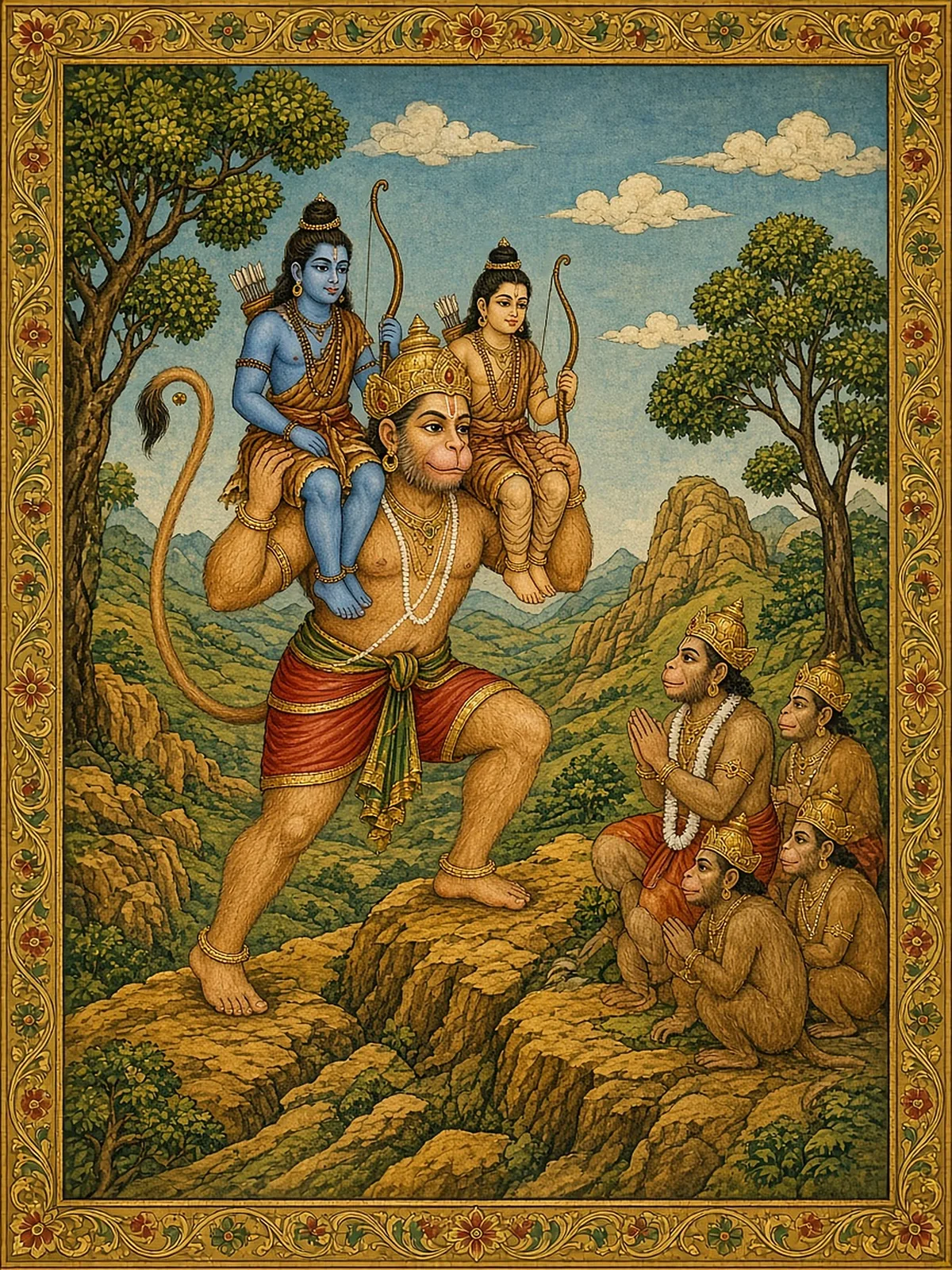
With this caupāī the Cālīsā turns from cosmic praise back to the narrative of the Rāmāyaṇa, specifically the Kiṣkindhākāṇḍa. Sugrīva, the younger brother of the vānara king Vālī, had been driven out of the kingdom of Kiṣkindhā by his brother, who also took his wife Rumā. Sugrīva lived in fear on the Ṛṣyamūka mountain with a few loyal ministers, chief among them Hanumān. When Rāma and Lakṣmaṇa came wandering in search of Sītā, Sugrīva feared they were warriors sent by Vālī, and sent Hanumān to find out. Hanumān, disguised (in the Mānasa, as a brāhmaṇa; in Vālmīki, as a mendicant), approached them, recognised Rāma, and brought about the alliance between Rāma and Sugrīva, sealed by a vow of friendship before a sacred fire. Rāma then slew Vālī and installed Sugrīva as king of Kiṣkindhā. The verse attributes this whole chain of grace to Hanumān’s upakāra — favour, benevolence. The devotional intent is to show Hanumān as the one who unites the soul with the Lord, and through that union restores what was lost.
Detailed Explanation
1. तुम उपकार सुग्रीवहिं कीन्हा (tuma upakāra sugrīvahiṃ kīnhā):
“You did a great favour to Sugrīva.”
- तुम (tuma): You.
- उपकार (upakāra): Favour / benefit / help / benevolence — a kindness that uplifts another.
- सुग्रीवहिं (sugrīvahiṃ): To Sugrīva (with the dative marker -hiṃ) — the exiled vānara prince, later king of Kiṣkindhā.
- कीन्हा (kīnhā): Did / performed.
Interpretation (elaborative):
Sugrīva’s situation before meeting Rāma is a picture of the soul in bondage. He has lost his kingdom, his wife and his peace; he lives in hiding, constantly afraid, protected only by the curse that prevents Vālī from entering Ṛṣyamūka. He has a few loyal friends, but no power to change his fate. Into this situation comes Hanumān, who does not merely comfort Sugrīva but connects him with the one being who can transform his life. This is the greatest upakāra one can do for another — not just to help with a problem, but to bring them to God. Hanumān remained loyal to Sugrīva throughout his exile, even though he himself was mighty enough to have stood alone; that loyalty is part of his greatness. The first meeting with Rāma is a masterpiece of Hanumān’s wisdom. He approaches cautiously, in disguise, and speaks with such grace that Rāma praises his learning. In the Mānasa, the moment Hanumān recognises his Lord, he falls at Rāma’s feet, reveals his true form, and pours out his heart, saying in effect: “I am foolish and deluded, Lord, and You too had forgotten me.” Rāma lifts him up, embraces him, and tells him he is dearer than Lakṣmaṇa. Then Hanumān carries Rāma and Lakṣmaṇa on his shoulders up the mountain to Sugrīva. Spiritually, Hanumān here functions as the Guru or the saint, who introduces the soul to God. Tulasīdāsa often says that without the grace of saints, one cannot reach Rāma. Practically, this line teaches that the greatest help we can give another is to bring them closer to goodness and to the Divine. It also encourages loyalty: Hanumān stood by Sugrīva in his darkest days, not only in his days of power.
2. राम मिलाय राज पद दीन्हा (rāma milāya rāja pada dīnhā):
“Uniting him with Śrī Rāma, you gave him the royal throne.”
- राम (rāma): Śrī Rāma.
- मिलाय (milāya): Having united / bringing together (causative of milanā, to meet).
- राज (rāja): Kingdom / royal.
- पद (pada): Position / status / throne — rāja pada, “the royal position, kingship”.
- दीन्हा (dīnhā): Gave / bestowed.
Interpretation (elaborative):
The sequence in this line is essential: first Rāma milāya — uniting with Rāma — and then rāja pada dīnhā — the giving of the kingdom. Union with the Lord comes first; restoration of what was lost follows. Sugrīva did not get his kingdom by fighting Vālī on his own; he had tried that and been defeated. He got it only after he had taken refuge in Rāma. In the Kiṣkindhākāṇḍa, Rāma promises to kill Vālī; at the first duel, Rāma cannot distinguish the two brothers, who look alike, and Sugrīva is beaten; at the second duel, wearing a garland given by Rāma to mark him, Sugrīva fights again, and Rāma fells Vālī with a single arrow. Sugrīva is crowned king and recovers his wife. It is notable that the Cālīsā credits Hanumān with giving Sugrīva the throne, though it was Rāma who slew Vālī. This is the logic of bhakti: the one who brings you to God is the giver of all that God then gives. Without Hanumān’s mediation, there would have been no alliance. There is also a warning embedded in the story. After becoming king, Sugrīva became absorbed in royal pleasures and forgot his promise to help search for Sītā during the rainy season. It was Hanumān who first reminded him of his duty, and later Lakṣmaṇa came in anger. Even after receiving grace, one can forget; and Hanumān remains the faithful reminder. Practically, this line encourages us to seek union with God first, trusting that what we truly need will follow. It also asks us not to forget God when prosperity comes, as Sugrīva briefly did, and to be grateful to those who brought us to the path.