Explanation
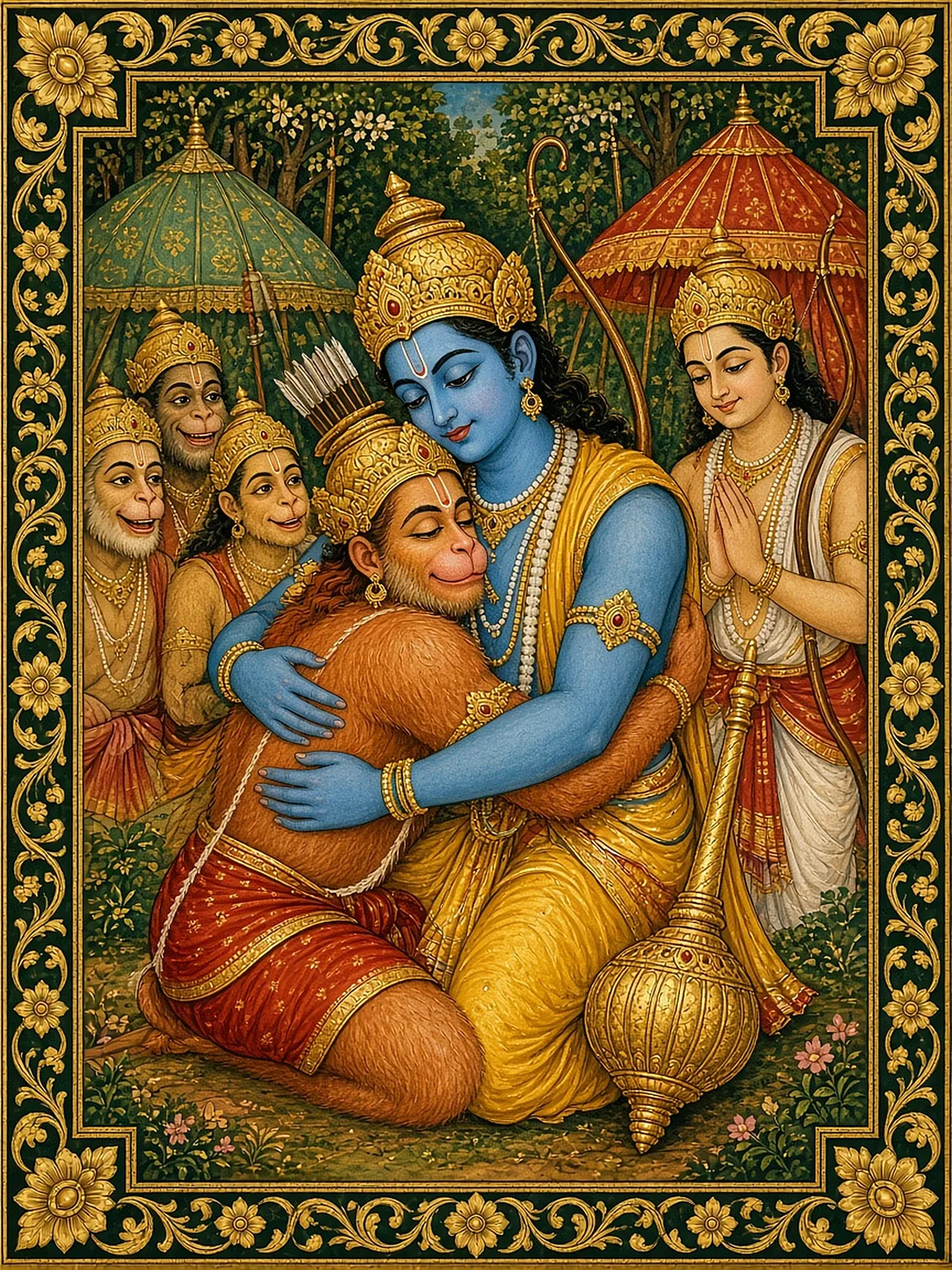
This caupāī records the Lord’s own words of praise for Hanumān. Rāma, the Lord of the Raghus, praised him abundantly and declared him as dear as Bharata, His own brother. To understand the weight of this statement, one must remember who Bharata is in the Rāmāyaṇa, and especially in the Rāmacaritamānasa, where he is portrayed as the supreme model of love for Rāma. When Bharata learned that his mother Kaikeyī had obtained the throne for him by sending Rāma into exile, he refused the kingdom, went to the forest to beg Rāma to return, and when Rāma would not break his father’s word, returned with Rāma’s sandals, placed them on the throne, and ruled for fourteen years as their servant, living like an ascetic outside Ayodhyā in Nandigrāma. Tulasīdāsa regards Bharata’s love as the very summit of devotion. To be placed by Rāma on a level with Bharata is therefore the highest honour a devotee can receive. In the Mānasa’s Kiṣkindhākāṇḍa, at their very first meeting, Rāma reassures Hanumān, “taiṃ mama priya lachimana te dūnā” — “You are twice as dear to me as Lakṣmaṇa.” The devotional intent of this verse is to reveal how greatly the Lord loves His devotee.
Detailed Explanation
1. रघुपति कीन्ही बहुत बड़ाई (raghupati kīnhī bahuta baṛāī):
“Raghupati praised you greatly.”
- रघुपति (raghupati): Lord of the Raghus — Śrī Rāma.
- कीन्ही (kīnhī): Did / made — Awadhi past tense of karanā (feminine, agreeing with baṛāī).
- बहुत (bahuta): Much / greatly / abundantly.
- बड़ाई (baṛāī): Praise / glorification / exaltation (from baṛā, great — “making great”).
Interpretation (elaborative):
It is one thing for devotees to praise the Lord; it is quite another for the Lord to praise the devotee. Here Rāma, the Supreme, sings the glory of His servant. This reversal is one of the deepest mysteries and joys of bhakti: the Lord, who needs nothing, makes Himself dependent on the love of His devotees, and delights to exalt them. In the Mānasa, when Hanumān returns from Laṅkā, Rāma says that among gods, men and sages there is no benefactor like him, that He cannot repay him, and that His mind cannot even face him for the weight of gratitude (“sunu kapi tohi samāna upakārī, nahiṃ kou sura nara muni tanudhārī; prati upakāra karauṃ kā torā, sanamukha hoi na sakata mana morā”). Hearing this, Hanumān falls at Rāma’s feet, overwhelmed, crying, “Save me, save me, Lord.” This is the sign of true greatness: when praised, the devotee does not swell with pride but becomes even more humble. Hanumān knew that praise is dangerous to the soul, and so he took refuge at the feet of the very one who praised him. The bahuta baṛāī — abundant praise — is described not to make Hanumān proud but to show us the Lord’s heart. God is not a cold judge; He is a loving master who notices and honours every effort made for Him. Practically, this line teaches two lessons. To those in positions of authority, it teaches the importance of praising those who serve well, generously and sincerely, as Rāma did. To the devotee, it teaches the right response to praise: gratitude and humility, offering the credit back to God. When praised, remember Hanumān at Rāma’s feet, and say inwardly, “It was all Your glory, Lord.”
2. तुम मम प्रिय भरतहि सम भाई (tuma mama priya bharatahi sama bhāī):
“‘You are as dear to me as my brother Bharata.’”
- तुम (tuma): You.
- मम (mama): My / to me (Sanskrit genitive).
- प्रिय (priya): Dear / beloved.
- भरतहि (bharatahi): (to) Bharata — Bharata + -hi, the Awadhi oblique/dative-accusative suffix (also written -hiṃ), here governed by sama: “equal to Bharata”.
- सम (sama): Equal / like / as.
- भाई (bhāī): Brother — qualifying Bharata (“brother Bharata”); some also read it as an affectionate address to Hanumān, “O brother!”
Interpretation (elaborative):
Why Bharata? Because in Tulasīdāsa’s vision Bharata is the purest of all lovers of Rāma. The Ayodhyākāṇḍa of the Mānasa — which, recall, opens with the very dohā that begins this Cālīsā — is in large part a hymn to Bharata’s love. He gave up the throne that was handed to him; he walked barefoot to the forest; he lived for fourteen years in austerity, ruling only as a trustee; he resolved to give up his life if Rāma did not return on the appointed day. Rāma constantly remembers Bharata in exile. To be compared to Bharata is to be told: “Your love for me is as pure as the purest love I know.” Notice the beautiful harmony between Bharata and Hanumān in the story. Hanumān carries the mountain past Ayodhyā and is brought down by Bharata’s arrow; the two great devotees meet and honour each other. And it is Hanumān whom Rāma sends ahead, after the victory, to inform Bharata that Rāma is returning — saving Bharata from the vow of self-immolation he had taken if Rāma did not return in time. Hanumān thus becomes the bearer of life to Bharata as he was to Lakṣmaṇa. The word bhāī, brother, expresses intimacy. Rāma does not see Hanumān as a mere servant or as a member of another species; he sees him as family, as a brother. In bhakti, the devotee’s outer status — high or low, learned or unlettered, human or animal — makes no difference. Love alone counts. Practically, this line gives every devotee hope: however humble our origin, we can become dear to God as His own family, through love and service. It also invites us to see others as Rāma saw Hanumān — as brothers and sisters, regardless of outward difference.