Explanation
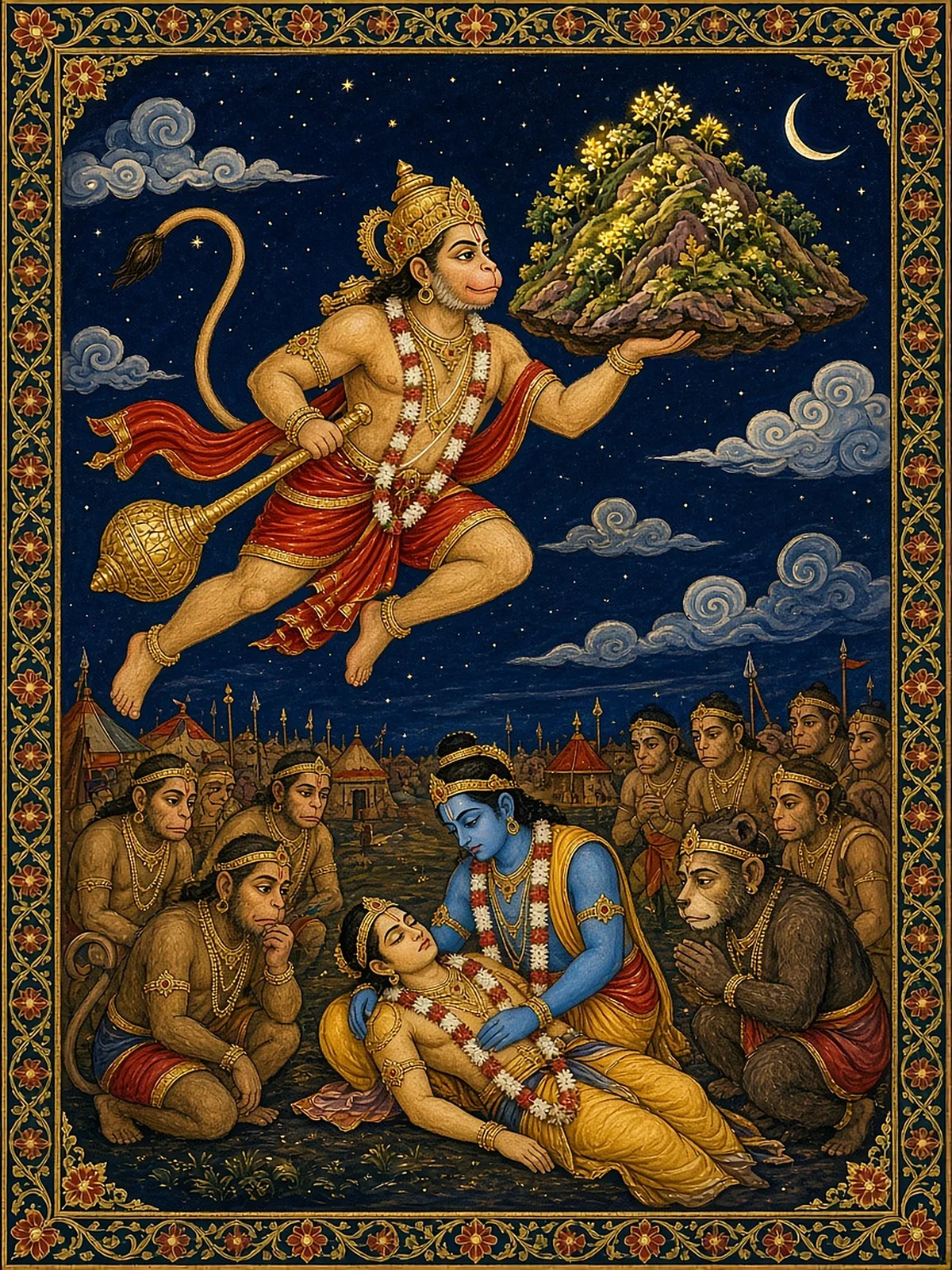
This caupāī recalls one of the most dramatic and moving episodes of the Rāmāyaṇa. During the war, Lakṣmaṇa was struck down — in the Mānasa, by the śakti weapon hurled by Meghanāda (Indrajit) — and lay lifeless on the battlefield. Rāma was plunged into grief. The physician Suṣeṇa (in the Mānasa, brought from Laṅkā by Hanumān) advised that only the sañjīvanī herb from a distant mountain in the Himālayas could save him, and it must be brought before dawn. Hanumān flew to the mountain and, unable to identify the herb, lifted the entire peak and carried it back through the sky. Lakṣmaṇa was revived, and Rāma, overwhelmed with joy, embraced Hanumān to His heart. The Vālmīki Rāmāyaṇa also describes Hanumān bringing the mountain of herbs to revive the wounded. The devotional intent is to present Hanumān as the bringer of life when all seems lost, and to show the depth of love between the Lord and His servant.
Detailed Explanation
1. लाय सजीवन लखन जियाये (lāya sajīvana lakhana jiyāye):
“Bringing the life-giving herb, you revived Lakṣmaṇa.”
- लाय (lāya): Having brought / bringing (from lānā, to bring).
- सजीवन (sajīvana): The life-restoring herb, Sañjīvanī — literally “that which (gives) life (jīvana) together/again”.
- लखन (lakhana): Lakṣmaṇa.
- जियाये (jiyāye): Revived / brought back to life / caused to live (causative of jīnā, to live).
Interpretation (elaborative):
The scene in the Mānasa is unforgettable. Lakṣmaṇa lies unconscious, the arrow of the śakti in his chest. Rāma, who has endured exile, the loss of his father and the abduction of Sītā with composure, now weeps like an ordinary human brother, lamenting that he could have borne the loss of wife and kingdom, but not of such a brother. Into this darkness comes Hanumān. The physician Suṣeṇa says the herb must arrive before sunrise. Hanumān sets out at once. On the way, in the Mānasa, Rāvaṇa sends the demon Kālanemi, disguised as a sage, to delay him; Hanumān sees through the disguise and slays him. At the mountain he cannot identify the herb, so he uproots the whole peak. Returning over Ayodhyā, he is shot down by Bharata, who mistakes him for a demon; Bharata, learning the truth, grieves, and offers to send him on with his own arrow — but Hanumān, praising Bharata, flies on by his own strength. He arrives in time, and Lakṣmaṇa rises as if from sleep. The word sajīvana carries a deeper meaning: that which restores life. When a devotee is spiritually “unconscious” — struck down by despair, temptation, grief or doubt — Hanumān brings the sañjīvanī of Rāma’s name and grace. Lakṣmaṇa, in some interpretations, represents the alert, devoted mind (Lakṣmaṇa is often understood to signify watchfulness, as he stayed awake guarding Rāma and Sītā in exile). When that alertness is struck down by the enemy, Hanumān revives it. Practically, this line is chanted especially in times of illness and crisis, by those who pray for a loved one’s recovery. It teaches that no situation is beyond hope while there is devotion, and that we too can be bringers of life to others — through care, through help at the right time, and through words that restore courage.
2. श्रीरघुबीर हरषि उर लाये (śrīraghubīra haraṣi ura lāye):
“Śrī Raghubīra, overjoyed, clasped you to His heart.”
- श्रीरघुबीर (śrīraghubīra): Śrī Raghubīra — the hero (bīra, vīra) of the Raghu dynasty, Rāma.
- हरषि (haraṣi): Rejoicing / overjoyed (Sanskrit harṣa, joy).
- उर (ura): Chest / bosom / heart (Sanskrit uras).
- लाये (lāye): Brought (you) to / clasped — ura lāye is the idiom “embraced, held to the heart”.
Interpretation (elaborative):
Of all the rewards Hanumān received, this is the one the Cālīsā chooses to mention: the embrace of Rāma. Kings reward servants with wealth, land and titles; Rāma gave Hanumān Himself. In the Mānasa, after Lakṣmaṇa is revived, Rāma joyfully embraces Hanumān, the poet calling the Lord supremely grateful and wise (ati kṛtagya prabhu parama sujānā). The Vālmīki Rāmāyaṇa records a similar scene after Hanumān’s return from Laṅkā, where Rāma, saying that he had nothing worthy to give in return, embraced Hanumān, declaring that this embrace was all he had to offer — an embrace that was, in effect, the gift of everything. The title Raghubīra here is meaningful: the great hero of the Raghu dynasty, before whom the mightiest warriors trembled, is himself moved to tears and embraces his servant. This reveals the heart of bhakti: God is not indifferent to the devotee’s love; He responds with greater love. Haraṣi, overjoyed — the Lord rejoices in the devotee. The embrace is also a spiritual symbol: the union of the individual soul with the Divine. Every act of selfless service draws the devotee closer to that embrace. Hanumān did not serve in order to be embraced; but because he served without seeking reward, he received the greatest reward of all. Practically, this line comforts the devotee: no service offered with love is ever unnoticed by God. It also guides us in how to respond to those who help us — with heartfelt gratitude, as Rāma did. Parents, teachers and leaders can learn from Rāma’s example: the warmest reward we can give another is not merely a gift, but recognition from the heart.