Explanation
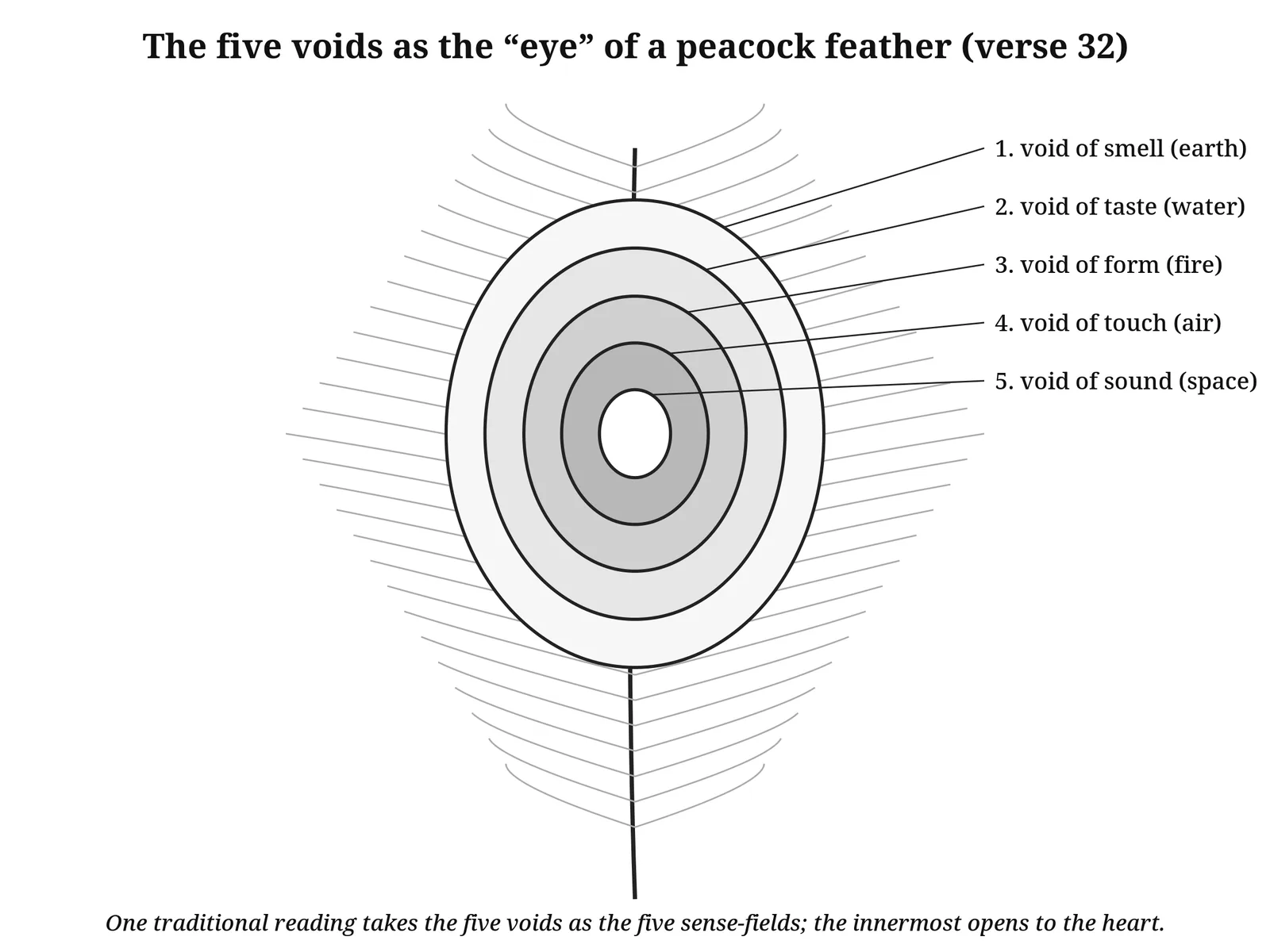
Dhāraṇā 9 introduces the theme of śūnya, void. The meditator contemplates five voids, visualised like the multicoloured eye-circles of a peacock's tail-feather. The five voids are interpreted by the commentators as the five senses (or their objects) understood as empty; by contemplating them, the mind enters anuttara śūnya, the supreme void, which is the heart. The image is beautiful and concrete, and the practice uses visual imagination to lead to emptiness. For the seeker, it introduces a key Trika insight: the void, rightly experienced, is the heart of consciousness.
Detailed Explanation
1. शिखिपक्षैश्चित्ररूपैर्मण्डलैः शून्यपञ्चकम् (śikhi-pakṣaiś citra-rūpair maṇḍalaiḥ śūnya-pañcakam):
“[Meditating on] the five voids (śūnya-pañcaka) as the variegated circles on a peacock’s feathers,”
- शिखिपक्षैः (śikhipakṣaiḥ) (tatpuruṣa cpd.; instr. pl. m.): By (or as) the feathers of the peacock; śikhin (“crested one, peacock”) + pakṣa (“feather, wing”), instrumental plural.
- चित्ररूपैः (citrarūpaiḥ) (bahuvrīhi; instr. pl. n.): Variegated — of variegated form.
- मण्डलैः (maṇḍalaiḥ) (instr. pl. n. of maṇḍala): With circles; the eye-spots on the peacock’s feathers.
- शून्यपञ्चकम् (śūnyapañcakam) (tatpuruṣa cpd. with pañcaka; acc. sg. n.): The five voids (śūnya-pañcaka) — the group of five voids.
Interpretation (elaborative): The peacock's tail-feather has a striking pattern: concentric rings of colour — gold, green, blue, black — around a dark centre. Śikhi-pakṣaiḥ citra-rūpair maṇḍalaiḥ, "with the variegated circles of the peacock's feathers", gives the image for meditation on the śūnya-pañcaka, the five voids. Kṣemarāja's and Śivopādhyāya's interpretations identify the five voids with the five senses (hearing, touch, sight, taste, smell) or with their five objects (sound, touch, form, taste, smell). Each is "void" because, when contemplated deeply, it is seen to be without independent substance. The peacock-feather circles serve as a visual support: one imagines five such circles, perhaps in five colours corresponding to the five elements, and then contemplates the emptiness at their centres. Swami Lakshmanjoo taught it as contemplating the five senses as five voids, one after another. For the practitioner, the dhāraṇā has a sensory, aesthetic quality typical of the Tantra. It does not reject the beauty of the world; it uses beauty as a doorway. The peacock was also sacred to Skanda and associated with Śiva's family; in Indian art its feathers symbolise the thousand eyes of awareness. One may begin by actually gazing at a peacock feather, then closing the eyes and contemplating its image, finally resting in the dark centre, the void.
2. ध्यायतोऽनुत्तरे शून्ये प्रवेशो हृदये भवेत् (dhyāyato 'nuttare śūnye praveśo hṛdaye bhavet):
“for one who meditates thus, there is entry into the heart, the supreme void.”
- ध्यायतः (dhyāyataḥ) (√dhyai, 1P; pres. part. dhyāyat, gen. sg. m.): For one who meditates; genitive of the present participle of √dhyai. ध्यायतः + अनुत्तरे → ध्यायतोऽनुत्तरे.
- अनुत्तरे (anuttare) (loc. sg. n. of anuttara): The supreme — in the unsurpassed; locative of anuttara (“that beyond which there is nothing”).
- शून्ये (śūnye) (loc. sg. n. of śūnya): In the void.
- प्रवेशः (praveśaḥ) (praveśa ← pra-√viś, 6P; nom. sg. m.): Entry.
- हृदये (hṛdaye) (loc. sg. n. of hṛdaya): In the heart.
- भवेत् (bhavet) (√bhū, 1P; opt. 3sg.): There is — would be.
Interpretation (elaborative): For one who meditates in this way, there is praveśa, entry, into the anuttara śūnya, the supreme void, which is hṛdaya, the heart. Anuttara, "beyond which there is nothing", is the highest name for the Absolute in the Trika, used by Abhinavagupta for the letter a and the ultimate reality of Parā. The hṛdaya, heart, in Kashmir Śaivism is not the physical organ but the centre of consciousness, the place where all experiences originate and come to rest. Abhinavagupta's Parātrīśikā calls the heart the essence of Śiva, the "heart of the Supreme" in which the universe throbs. The equation of the supreme void and the heart is decisive: the void is not an absence but the inner core of awareness, open, luminous and alive. By contemplating the five senses as voids, the mind is drawn away from their objects to their source, which is the heart. For the practitioner, this dhāraṇā trains a way of perceiving. When seeing, notice the space in which seeing happens; when hearing, notice the silence from which sounds arise. These voids, the "eye-circles" of each sense, all open into a single void, the heart. Resting there, one finds the supreme state described in verse 15: bliss of one's own inner experience, free from thought, full.
Practice Guide
Practice Guide — Dhāraṇā 9 (verse 32)
Preparation & Posture
Sit comfortably with the spine upright, eyes closed. If possible, look at a peacock feather or a picture of one for a minute beforehand so that the image of its concentric "eye" is fresh. Breathe naturally and let the body settle before beginning.
Step-by-Step Method
1. Recall the image of the peacock feather's eye: several concentric rings of colour around a dark centre.
2. Understand the five rings as the five voids (śūnya-pañcaka), traditionally the five senses or the five elements each emptied of content.
3. Begin with the outermost ring, the void of smell or earth, and feel it as empty space rather than as a sense.
4. Move inward ring by ring: the void of taste or water, of sight or fire, of touch or air, of hearing or space.
5. Let each ring be experienced as empty, open and luminous, not as a colour to be held.
6. As you pass inward, feel the rings narrowing toward the centre.
7. Enter the dark centre of the eye: the heart, which the verse calls the supreme void.
8. Rest there without any image, simply present in the open heart, and remain for some minutes before slowly opening the eyes.
Beginner variation: contemplate the feather's eye as a picture with the eyes open, then close the eyes and rest only in its dark centre, felt in the heart.
Duration & Frequency
Beginners: 10–15 minutes daily. Established practitioners: 20–30 minutes, letting the passage through the five rings become quicker and the resting in the centre longer.
Signs of Progress
The senses quieten one by one; a sense of spaciousness grows; entry into the heart feels like coming home; afterwards there is calm, openness and a softened sense of the senses.
Common Mistakes
Turning the practice into colour visualisation; worrying about which ring corresponds to which sense; tensing the eyes; trying to make the heart a visual object; rushing the passage instead of letting each void be felt.
Cautions
Generally gentle. Practices of emptiness can occasionally bring up unease or a sense of unreality; if this happens, open the eyes, feel the body and the ground, and return to simpler breath practices. Those with a history of dissociation should practise only with guidance.
Integration into Daily Life
When the senses feel overloaded, close the eyes for a moment and rest in the quiet centre of the chest.
Related dhāraṇās: the void practices continue in Dhāraṇās 10 and 20–25 (verses 33, 43–48); the heart returns in Dhāraṇā 26 (verse 49).
Traditional guidance, not medical advice; see “A Note on Safe Practice” in the Introduction.