Explanation
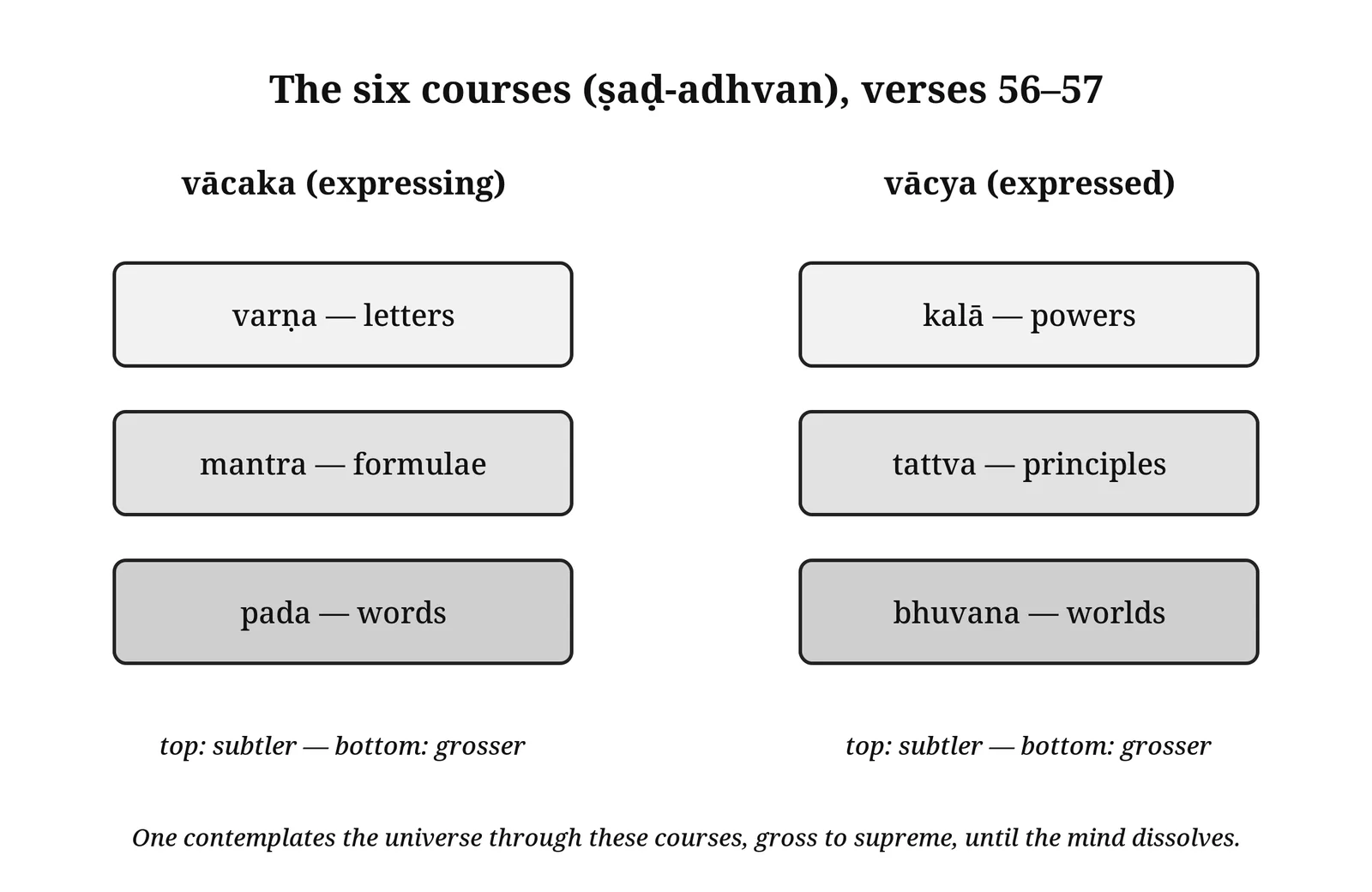
Dhāraṇā 33 introduces the ṣaḍadhvan, the six courses or paths of manifestation central to Tantric ritual: varṇa (letters), mantra, pada (words), kalā (powers), tattva (principles) and bhuvana (worlds). The meditator contemplates the universe through these courses, beginning with the worlds (bhuvanādhvan), in their gross, subtle and supreme aspects, until the mind dissolves. For the seeker, it is a comprehensive cosmological meditation that leads from the vast to the transcendent.
Detailed Explanation
1. भुवनाध्वादिरूपेण चिन्तयेत्क्रमशोऽखिलम् (bhuvanādhvādi-rūpeṇa cintayet kramaśo 'khilam):
“One should contemplate the whole [universe] in order through the forms of the course of the worlds (bhuvanādhvan) and the other courses,”
- भुवनाध्वादिरूपेण (bhuvanādhvādirūpeṇa) (cpd.; adhvan, ādi; instr. sg. n.): In the form of the course of the worlds and the others; bhuvana (“world”) + adhvan (“path, course”) + ādi + rūpa, instrumental.
- चिन्तयेत् (cintayet) (√cint, 10U; opt. 3sg.): Should contemplate.
- क्रमशः (kramaśaḥ) (indecl.; krama + -śas): In order, step by step. क्रमशः + अखिलम् → क्रमशोऽखिलम्.
- अखिलम् (akhilam) (acc. sg. n.): The whole.
Interpretation (elaborative): In Śaiva Tantra, the universe is mapped by the ṣaḍadhvan, the sixfold path. Three courses belong to the side of the subject (vācaka, the denoting): varṇa, mantra and pada. Three belong to the side of the object (vācya, the denoted): kalā, tattva and bhuvana. The bhuvanādhvan, course of worlds, is the grossest, comprising 118 or 224 worlds (depending on the system) from the lowest hell to the highest heaven. Abhinavagupta devotes chapters of the Tantrāloka to each adhvan. In initiation (dīkṣā), the Guru purifies the disciple's bonds in each adhvan. This dhāraṇā uses the same scheme for meditation: one contemplates kramaśaḥ, in order, the whole universe through these courses. For the practitioner without detailed knowledge of the worlds, the practice may be simplified: contemplate the physical world, then the subtle worlds of thought and feeling, then the causal world of pure potential, each as a level of one's own consciousness. The essential point is to traverse the whole of manifestation in awareness, recognising that it is all contained in consciousness. The six adhvans (courses) are: varṇa (letters), mantra, pada (words), kalā (phases), tattva (principles) and bhuvana (worlds). The first three belong to the side of sound (vācaka), the last three to the side of objects (vācya). Abhinavagupta devotes a large part of the Tantrāloka to them, since initiation (dīkṣā) traditionally purifies the disciple along these six paths. Here the practitioner performs a contemplative version of that purification, beginning with the grossest course, the worlds, and moving inward. The word akhilam, "the whole", reminds that nothing is left outside the contemplation: every world, every element and every sound is included, so that the dissolution, when it comes, is complete.
2. स्थूलसूक्ष्मपरस्थित्या यावदन्ते मनोलयः (sthūla-sūkṣma-para-sthityā yāvad ante mano-layaḥ):
“through their gross, subtle and supreme states, until at the end the mind dissolves.”
- स्थूलसूक्ष्मपरस्थित्या (sthūlasūkṣmaparasthityā) (dvandva + sthiti; instr. sg. f.): Through the gross, subtle and supreme states.
- यावत् (yāvat) (indecl.): Until.
- अन्ते (ante) (loc. sg. m. of anta): At the end.
- मनोलयः (manolayaḥ) (tatpuruṣa cpd.; laya ← √lī; nom. sg. m.): The mind dissolves — dissolution of the mind.
Interpretation (elaborative): Each course is contemplated in its sthūla, sūkṣma and para states, the same triad found in verse 30. The sthūla form of the worlds is their outer appearance; the sūkṣma form is their subtle structure in the mind; the para form is their essence in pure consciousness. Kṣemarāja explains that the bhuvanas are gross, the tattvas subtle and the kalās supreme. Moving through these levels, the mind is drawn from the vast multiplicity of worlds to their subtle principles and then to their source. Yāvad ante mano-layaḥ: one continues until, at the end, the mind dissolves. The mind cannot hold the entire universe in all its levels; at some point it is overwhelmed and stops. This overwhelming is the doorway. For the practitioner, the dhāraṇā can produce a sense of awe at the vastness of creation. Let the mind expand to include all worlds, then all principles, then pure power, until it can expand no further and simply dissolves. The dissolution is not a loss but an entry into the consciousness that contains all worlds. This practice is suited to those with a contemplative, cosmological temperament. The phrase yāvad ante, "until at the end", points to perseverance: the contemplation continues until the mind actually dissolves, not merely until one has gone through the list. Śivopādhyāya observes that many practitioners stop when the conceptual review is finished, missing the culmination. The three stages — gross, subtle, supreme — correspond to the sthūla, sūkṣma and para levels of every reality. When even the supreme level is passed through, mind dissolves in the source.
Practice Guide
Practice Guide — Dhāraṇā 33 (verse 56)
Preparation & Posture
Sit upright, eyes closed, in a quiet place. This practice uses the traditional six courses (ṣaḍ-adhvan) of Trika: the worlds (bhuvana), the principles (tattva) and the powers (kalā) on the side of the object, and the letters (varṇa), the mantras and the words (pada) on the side of sound. It helps to look at Figure 7 and to read a simple description beforehand. Breathe naturally and let the mind settle.
Step-by-Step Method
1. Begin with the course of the worlds (bhuvanādhvan): contemplate the outer world in its grossest form, the earth, the places and beings you know.
2. Let it become subtler: the world as composed of principles (tattvas), the elements, senses and mind.
3. Let it become subtler still: the world as made of powers (kalās), the forces that hold the principles together.
4. Turn to the side of sound: contemplate the world as words (pada), then as mantras, then as the letters (varṇa) from which they arise.
5. At each stage, move from gross to subtle to supreme, as the verse says.
6. Take two or three minutes at each stage, letting the previous one fade before the next.
7. Continue until the mind itself dissolves, "at the end", as the verse says.
8. Rest in that dissolution, then return gently to the body and open the eyes.
What to notice. At first the courses are mainly ideas; let them become felt: the solidity of the world, the inner structure of the senses and mind, the faint vibration of sound. Notice how each subtler level makes the previous one seem less solid. At the end, notice the moment when there is nothing left to contemplate; the mind falls silent and simple awareness remains.
Beginner variation: contemplate the world in three stages: as solid things, as energy and movement, and as silent awareness.
Duration & Frequency
Beginners: 10–15 minutes, using the beginner variation. Established practitioners: 20–40 minutes, with the full sequence.
Signs of Progress
Increasing subtlety of perception; a sense of the world as layered and transparent; the mind dissolving; afterwards a fresh, open perception of things.
Common Mistakes
Getting lost in theory; rushing; worrying about the exact scheme; not allowing the final dissolution.
Cautions
If you feel ungrounded or confused, end by feeling the body and the floor, and open the eyes.
Integration into Daily Life
Notice for a moment how a familiar object can be seen as matter, as energy and as appearance in awareness.
Related dhāraṇās: continues in Dhāraṇā 34 (verse 57); compare Dhāraṇā 31 (verse 54) and see Figure 7.
Traditional guidance, not medical advice; see “A Note on Safe Practice” in the Introduction.