Explanation
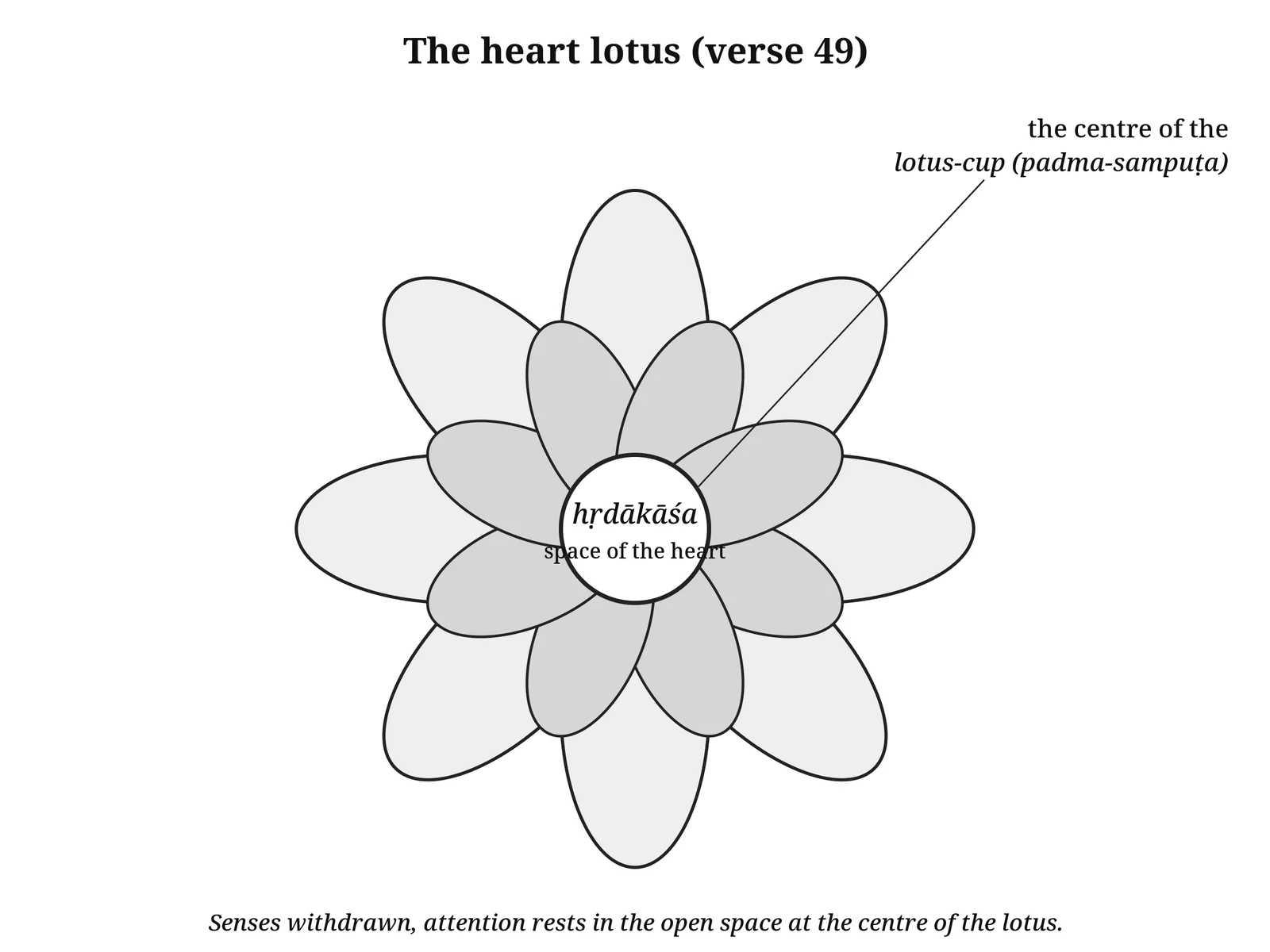
Dhāraṇā 26 is a meditation on the heart. The meditator withdraws the senses into the hṛdyākāśa, the space of the heart, and enters the centre of the heart-lotus, whose petals are closed like a cup (sampuṭa). With undivided attention, he attains supreme saubhāgya, blessedness. The address to Devī as subhagā, "blessed one", resonates with the result. For the seeker, the verse offers one of the classic Tantric meditations: resting in the heart.
Detailed Explanation
1. हृद्याकाशे निलीनाक्षः पद्मसम्पुटमध्यगः (hṛdy-ākāśe nilīnākṣaḥ padma-sampuṭa-madhyagaḥ):
“One whose senses are absorbed in the space of the heart, who has entered the centre of the lotus-cup,”
- हृद्याकाशे (hṛdyākāśe) (aluk tatpuruṣa cpd. hṛdi + ākāśa; loc. sg. m.): In the space of the heart; hṛdi (“in the heart”) + ākāśa. Often taken as hṛd-ākāśa.
- निलीनाक्षः (nilīnākṣaḥ) (bahuvrīhi; nilīna ← ni-√lī, p.p.p.; nom. sg. m.): One whose senses (or eyes) are absorbed; nilīna (“dissolved, absorbed”) + akṣa (“eye, sense”), bahuvrīhi.
- पद्मसम्पुटमध्यगः (padmasampuṭamadhyagaḥ) (upapada cpd. with -ga ← √gam; nom. sg. m.): Who has entered the centre of the lotus-cup — who has gone into the middle of the lotus-cup; padma (“lotus”) + sampuṭa (“closed cup, casket”) + madhya + ga (“going”).
Interpretation (elaborative): The hṛdyākāśa, the space of the heart, is a classical object of meditation in the Upaniṣads, where it is called the dahara ākāśa, the "small space" in the heart in which the whole universe is contained (Chāndogya 8.1). In Kashmir Śaivism the heart is the centre of spanda, the throb of consciousness. The meditator is nilīnākṣa, one whose senses (akṣa) are absorbed (nilīna) in this space: the senses are withdrawn from their objects and gathered into the heart. Padma-sampuṭa-madhyaga, "who has entered the centre of the lotus-cup", refers to the heart-lotus, whose petals close like the two halves of a casket (sampuṭa). In the Trika, sampuṭa also means the enclosing of one mantra by another, symbolising the union of Śiva and Śakti; the heart is the place where they embrace. Kṣemarāja explains that the meditator should feel himself entering the very centre of the heart-lotus, where the petals enclose a space of light. For the practitioner: close the eyes, withdraw attention from the senses, and let it sink into the chest. Imagine a lotus there, its petals gently closed, and feel yourself entering its centre. Rest in the space within, warm, quiet and luminous. The image of the padma-sampuṭa, the lotus with petals folded together like a casket, suggests intimacy and protection: the heart's space is a secret, enclosed sanctuary. Kṣemarāja says that the practitioner should enter it as one enters the inner shrine of a temple, with reverence and silence. The closed eyes (nilīnākṣa) indicate total withdrawal from the outer world, but the inner space is not dark; it is luminous with the light of consciousness.
2. अनन्यचेताः सुभगे परं सौभाग्यमाप्नुयात् (ananya-cetāḥ subhage paraṃ saubhāgyam āpnuyāt):
“with undivided mind, O blessed one, attains the supreme good fortune.”
- अनन्यचेताः (ananyacetāḥ) (bahuvrīhi; nom. sg. m.): With undivided mind.
- सुभगे (subhage) (voc. sg. f. of subhaga): O blessed, beautiful one; vocative of subhagā.
- परम् (param) (acc. sg. n. of para): Supreme.
- सौभाग्यम् (saubhāgyam) (vṛddhi abstract of subhaga; acc. sg. n.): Good fortune — blessedness, good fortune, beauty; abstract of subhaga.
- आप्नुयात् (āpnuyāt) (√āp, 5P; opt. 3sg.): Attains; optative of √āp.
Interpretation (elaborative): With ananya-cetāḥ, undivided mind, one attains paraṃ saubhāgyam, the supreme good fortune. Saubhāgya means good fortune, happiness, beauty and also the blessedness of a married woman, especially in union with her beloved. Devī is addressed as subhagā, "O blessed one", making a play on words: the blessed one is told how to attain supreme blessedness. In Śrīvidyā and Trika, saubhāgya is a name of the Goddess's grace and of the bliss of union of Śiva and Śakti. The heart is where this union takes place; resting there, the practitioner shares in the divine marriage. Kṣemarāja comments that saubhāgya here is the state of ānanda, the bliss of consciousness that arises when awareness rests in its own centre. For the practitioner, the language of blessedness and beauty is a reminder that the Tantra's path is not dry or ascetic. The experience of the heart is often accompanied by tenderness, joy and a sense of being loved. One should welcome these feelings and let them deepen. The condition is undivided attention: the mind must not wander elsewhere. When it wanders, gently bring it back to the heart. Over time, the heart becomes a natural home, and the supreme blessedness becomes a constant undercurrent of life.
Practice Guide
Practice Guide — Dhāraṇā 26 (verse 49)
Preparation & Posture
Sit upright, eyes closed, the chest open and relaxed, hands resting in the lap. Breathe naturally for a few minutes and bring attention to the centre of the chest. Some practitioners place one hand lightly on the heart at the start to help locate it.
Step-by-Step Method
1. Bring attention to the space of the heart at the centre of the chest.
2. Contemplate there a lotus, its petals closed, like a cup (kamala-saṃpuṭa).
3. Enter the centre of the lotus-cup with attention, as the verse says.
4. Let the senses withdraw into that space, one by one: first hearing, then sight, touch, taste and smell.
5. Keep the mind "undivided", resting only in the heart.
6. Notice the space inside the lotus as warm, open and luminous.
7. Rest there with gentle devotion, without seeking anything; this, the verse says, brings supreme good fortune.
8. End by feeling the whole body, letting attention rest at the heart for a few moments longer, and opening the eyes.
What to notice. At first the heart may be felt only as a physical area or a faint warmth. As the senses withdraw, notice outer sounds and sensations becoming distant, and a felt space opening at the centre of the chest. Entering the lotus-cup often brings a sense of intimacy, safety or tenderness. As the mind becomes undivided, the feeling of a separate meditator softens into simple, contented presence.
Beginner variation: rest attention in the centre of the chest, feeling warmth or openness there, without any image, for 5–10 minutes.
Duration & Frequency
Beginners: 10–15 minutes. Established practitioners: 20–40 minutes, as a central daily practice.
Signs of Progress
The senses quieten; a deep feeling of warmth, intimacy and peace in the heart; the mind becomes undivided and still; afterwards a lasting sense of contentment and kindness.
Common Mistakes
Visualising a complex lotus; tensing the chest; seeking emotional excitement; concentrating with force; leaving the heart to follow thoughts.
Cautions
A gentle practice. If strong emotion arises, let it pass and return to the breath; if you have heart conditions, keep the attention very soft and avoid dwelling on physical sensations.
Integration into Daily Life
Before speaking with someone, feel the heart for one breath.
Related dhāraṇās: compare Dhāraṇā 9 (the heart as the supreme void, verse 32), Dhāraṇā 14 (verse 37), and see Figure 5.
Traditional guidance, not medical advice; see “A Note on Safe Practice” in the Introduction.