Explanation
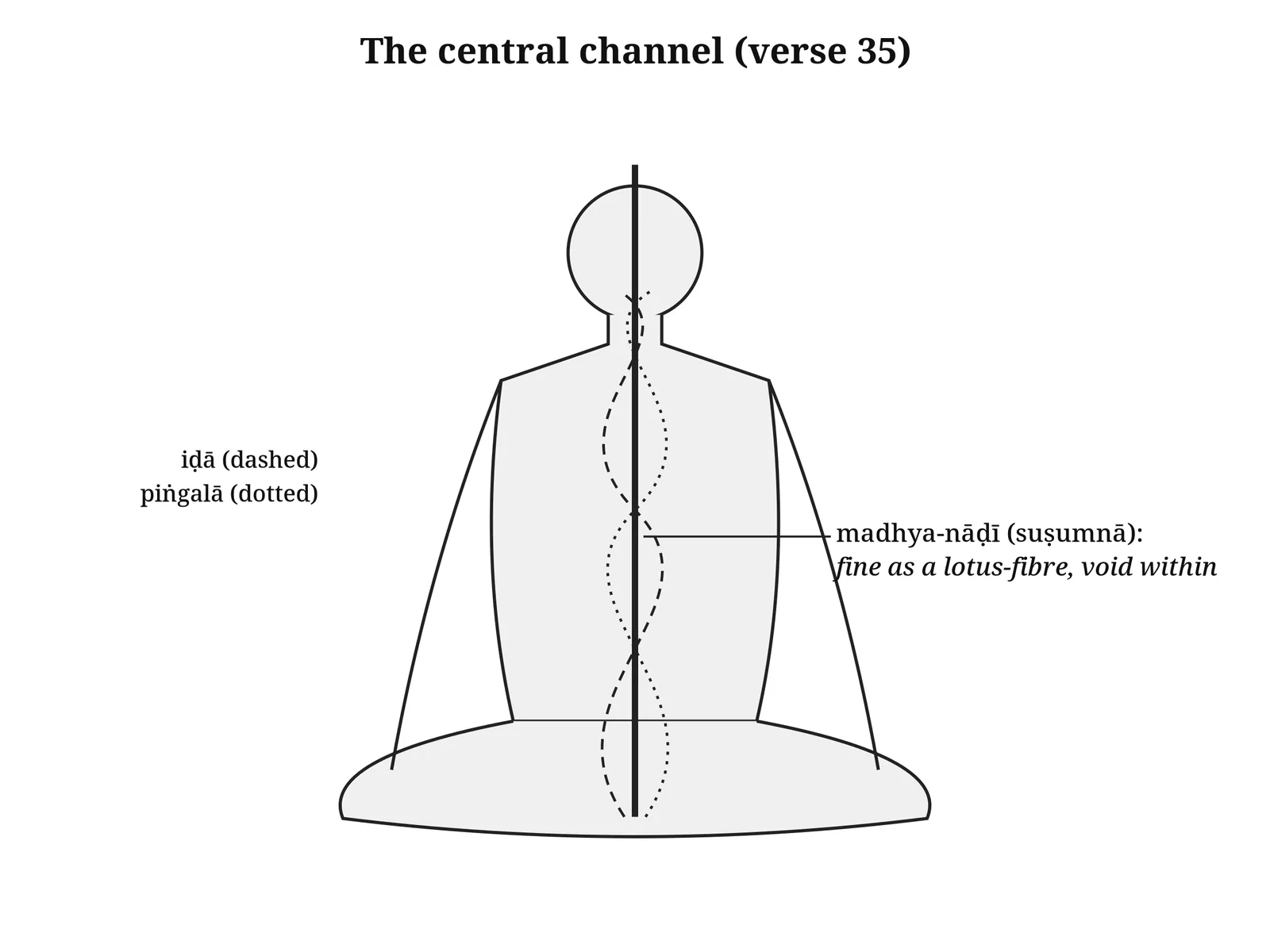
Dhāraṇā 12 focuses on the suṣumnā, the central channel of the subtle body. One meditates on it as a fine, hollow thread, like the fibre of a lotus stalk, and as the Goddess herself, empty within. Through this meditation the Lord shines forth. The verse unites the anatomy of yoga with the theology of Śakti: the central channel is the Goddess, and its emptiness is the space where Śiva is revealed. For the seeker, it gives a precise inner image for meditation and links with the doctrine of madhya.
Detailed Explanation
1. मध्यनाडी मध्यसंस्था बिससूत्राभरूपया (madhya-nāḍī madhya-saṃsthā bisa-sūtrābha-rūpayā):
“The central channel (madhya-nāḍī), situated in the middle, having the form of a lotus-fibre —”
- मध्यनाडी (madhyanāḍī) (karmadhāraya cpd.; nom. sg. f.): The central channel; madhya (“middle”) + nāḍī (“channel, conduit”).
- मध्यसंस्था (madhyasaṃsthā) (saṃsthā ← sam-√sthā, 1P; nom. sg. f.): Situated in the middle.
- बिससूत्राभरूपया (bisasūtrābharūpayā) (bahuvrīhi; ābha + rūpa; instr. sg. f.): Having the form of a lotus-fibre — with the form resembling a lotus-fibre; bisa (“lotus stalk”) + sūtra (“thread”) + ābha (“like”) + rūpa, instrumental feminine.
Interpretation (elaborative): The madhya-nāḍī, central channel, is the suṣumnā, which runs from the base of the spine to the crown. It is madhya-saṃsthā, located in the middle, between the iḍā and piṅgalā channels associated with the in-breath and out-breath. Its form is bisa-sūtrābha, "having the form of a lotus-fibre": when a lotus stalk is broken, fine, white threads appear, extremely thin yet strong. This image is classical in yoga texts for the subtlety of the central channel. In Kashmir Śaivism the central channel is not only an anatomical structure; it is the madhya, the centre of consciousness, and Kṣemarāja identifies it with the suṣumnā through which the udāna rises when prāṇa and apāna are balanced. Meditating on it as a fine thread draws the mind into extreme subtlety, and subtlety itself leads toward the formless. For the practitioner, visualise a fine, luminous thread running through the centre of the body, from the base to the crown, as delicate as a lotus fibre. Let the attention rest in it, gently moving up and down, or simply abiding in its entire length. This visualisation centres the energies of the body and calms the mind. With practice, one begins to feel the central axis as a channel of light and stillness.
2. ध्यातान्तर्व्योमया देव्या तया देवः प्रकाशते (dhyātāntar-vyomayā devyā tayā devaḥ prakāśate):
“through meditation on that Devī whose inner space is void, the Deva is revealed.”
- ध्याता (dhyātā) (√dhyai, 1P; p.p.p. dhyāta, nom. sg. f.): Meditation (“through meditation on”) — meditated upon; past participle of √dhyai (here read with अन्तर्व्योमया as a compound by many editors: “by the Goddess meditated upon as having inner space”).
- अन्तर्व्योमया (antarvyomayā) (bahuvrīhi antar-vyoman; instr. sg. f.): Having an inner void/space; antar + vyoman (“sky, space”), instrumental feminine.
- देव्या (devyā) (instr. sg. f. of devī): On that Devī — by the Goddess; instrumental.
- तया (tayā) (instr. sg. f. of tad): By her.
- देवः (devaḥ) (nom. sg. m.): The Deva — the God.
- प्रकाशते (prakāśate) (pra-√kāś, 1Ā; pres. 3sg.): Is revealed — shines forth.
Interpretation (elaborative): The central channel is now identified with Devī, the Goddess. She is antar-vyomā, "having space within", i.e., hollow, empty in the middle. By meditating on her (dhyātā), devaḥ prakāśate, the God shines forth. This is again the doctrine of verse 20: Śakti is the door to Śiva. The central channel is Śakti; its inner void is the space in which Śiva shines. The emptiness inside the fine thread is particularly significant. Kṣemarāja explains that the meditator should not only visualise the channel but enter its inner space, the vyoman, which is void of all objects. That void is the madhya-dhāma, the central abode, the heart of consciousness. When the mind enters there, all dualities are suspended, and the Lord is revealed. For the practitioner, the meditation has two stages. First, visualise the central channel as a fine thread of light. Then, sense the emptiness within it, a hollow tube of pure space. Let the attention dissolve into that inner space. The thread is the Goddess; the space inside is the doorway; what shines when one enters is the God. This dhāraṇā elegantly unites visualisation (āṇava), the feeling of energy (śākta) and the recognition of the void (śāmbhava). The verse thus presents the relationship of Śiva and Śakti in miniature: the Goddess is contemplated, and through her the God shines. This pattern recurs throughout the Tantra (verses 20, 155): Śakti is always the doorway, Śiva the realisation. Abhinavagupta calls Śakti the "face" (mukha) of Śiva, through which he is approached. The practitioner who finds devotion to the Goddess natural may let this line deepen that devotion, knowing that loving her inner form is the most direct way to the Lord's radiance.
Practice Guide
Practice Guide — Dhāraṇā 12 (verse 35)
Preparation & Posture
Sit with the spine erect and balanced, the neck in line with the spine, eyes closed. The posture should allow the central axis of the body to be felt as a straight, relaxed line. Breathe naturally and spend a few minutes scanning gently from the base of the spine to the crown.
Step-by-Step Method
1. Bring attention to the centre of the body, the line running through the middle from the base of the spine to the crown.
2. Picture there the central channel (madhya-nāḍī), as fine as the fibre of a lotus stalk.
3. Let it be felt as luminous but extremely delicate, not as a tube or a muscle.
4. Contemplate it, as the verse says, as the Devī herself, whose inner space is void.
5. Rest attention within the channel, not on its surface, feeling the emptiness inside it.
6. When the mind wanders, return to the fine, empty line at the centre.
7. As the practice deepens, let the image of the channel fade, keeping only the sense of central emptiness and openness.
8. Rest in that emptiness, in which, the verse says, the Deva is revealed; end with a few minutes of natural breathing and gentle movement.
Beginner variation: simply feel the spine as a straight, quiet line for 5 minutes, without any image of a channel.
Duration & Frequency
Beginners: 10–15 minutes. Established practitioners: 20–40 minutes, at the same time each day if possible.
Signs of Progress
A stable sense of a central axis; the body feels light and transparent; thought becomes sparse; a quiet, open emptiness at the centre; afterwards, steadiness and inner balance.
Common Mistakes
Making the channel thick or tube-like; straining to see it; tensing the spine; holding the breath; trying to push energy up the channel; neglecting to let the image dissolve.
Cautions
Practise gently. If strong sensations of heat, energy movement, pressure in the head or agitation arise, stop and ground yourself through walking and ordinary activity; resume more lightly. Emptiness practice can sometimes bring up unease; open the eyes and feel the body if this happens.
Integration into Daily Life
When walking, feel the central axis as a fine, upright line of light for a few steps.
Related dhāraṇās: the channel is the path of Dhāraṇās 5–8; see Figure 4 and Dhāraṇā 3 (the centre, verse 26).
Traditional guidance, not medical advice; see “A Note on Safe Practice” in the Introduction.