Explanation
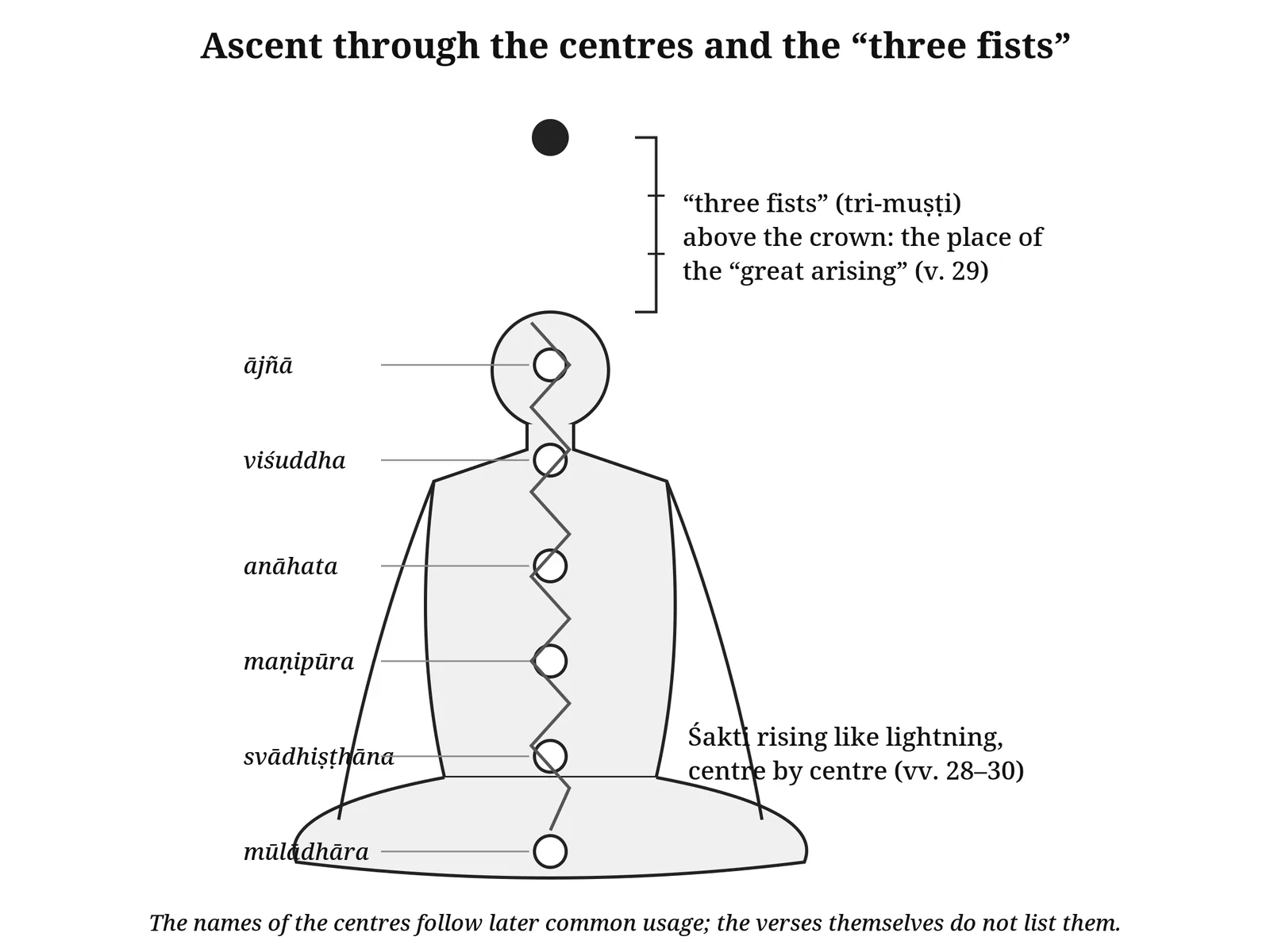
Dhāraṇā 6 describes a more dynamic form of the ascent: Śakti rises like lightning (taḍit) from cakra to cakra, until a point three fists (about twelve finger-breadths) above the head. At the end there is mahodaya, the great dawn. Where verse 28 emphasised a gradual, subtle ray, this verse speaks of swift, electric movement, suited to those of more intense temperament. For the seeker, the two verses show that the same ascent can be experienced in different ways, gentle or vivid, but the culmination is always the dissolution into the space beyond the body.
Detailed Explanation
1. उद्गच्छन्तीं तडिद्रूपां प्रतिचक्रं क्रमात्क्रमम् (udgacchantīṃ taḍid-rūpāṃ praticakraṃ kramāt kramam):
“[One should contemplate her] rising like lightning through each cakra, step by step,”
- उद्गच्छन्तीम् (udgacchantīm) (ud-√gam, 1P; pres. part. udgacchantī, acc. sg. f.): Rising, ascending; present participle of ud-√gam, feminine accusative.
- तडिद्रूपाम् (taḍidrūpām) (bahuvrīhi; acc. sg. f.): Like lightning — in the form of lightning; taḍit (“lightning”) + rūpa. The source’s तडित्रूपां has been corrected (t + r → d by sandhi).
- प्रतिचक्रम् (praticakram) (avyayībhāva cpd.; indecl.): At each cakra; prati- + cakra, avyayībhāva.
- क्रमात्क्रमम् (kramātkramam) (indecl.; kramāt + kramam): Step by step, one after another.
Interpretation (elaborative): Here Śakti is visualised as taḍit, lightning, flashing upward praticakram, through each cakra in turn. The cakras in Kashmir Śaiva texts are not always the familiar seven; the Netra Tantra and Tantrāloka list various systems of five, six or more centres. Kṣemarāja in his commentary on the Netra Tantra mentions six cakras along the spine and above. The lightning image expresses brilliance, speed and power. In the experience of awakened kuṇḍalinī, practitioners describe a sudden rush of energy, like an electric current, moving up the spine. The phrase kramāt kramam, "step by step", qualifies this: the lightning is not chaotic but passes successively through each centre, illuminating and purifying it. For the practitioner, this dhāraṇā is more vivid than the previous one. One may visualise a flash of light at the base, then at the navel, the heart, the throat, between the eyebrows, and at the crown, each time a little brighter and swifter. Some teachers advise synchronising this with the breath. As always, the emphasis is not on forcing but on visualising and feeling. If energy does awaken spontaneously, the instruction is to allow it to rise without fear, maintaining awareness, and to let it complete its ascent. The repetition kramāt kramam, "step by step", balances the suddenness of lightning: the flash is instantaneous at each station, yet the stations are traversed in order. Abhinavagupta describes this rhythm in the Tantrāloka as the characteristic movement of prāṇa-kuṇḍalinī, which pierces each knot (granthi) in a flash and then pauses before the next. Practitioners often report a sense of brightening or warmth at each centre; such signs should be noticed and released, not grasped, since the goal lies at the summit.
2. ऊर्ध्वं मुष्टित्रयं यावत्तावदन्ते महोदयः (ūrdhvaṃ muṣṭi-trayaṃ yāvat tāvad ante mahodayaḥ):
“up to three fists above [the head]; at its end, there is the great arising (mahodaya).”
- ऊर्ध्वम् (ūrdhvam) (indecl.; acc. sg. n. of ūrdhva used adverbially): Above.
- मुष्टित्रयम् (muṣṭitrayam) (dvigu cpd.; acc. sg. n.): Three fists; muṣṭi (“fist”, a measure of about four finger-breadths) + traya.
- यावत् (yāvat) (indecl.): Up to — as far as.
- तावत् (tāvat) (indecl.): So far, then.
- अन्ते (ante) (loc. sg. m. of anta): At the end.
- महोदयः (mahodayaḥ) (karmadhāraya mahā + udaya; nom. sg. m.): The great arising, great dawn; mahā + udaya.
Interpretation (elaborative): The lightning rises ūrdhvaṃ muṣṭi-trayam, "three fists above". A fist (muṣṭi) is about four fingers, so three fists equal twelve fingers, again the dvādaśānta. The goal is beyond the body: the ascending energy leaves the confines of the physical form and opens into the space above. There, ante, "at its end", is mahodaya, the great dawning. Udaya means rising, as of the sun; mahā-udaya is the great sunrise of consciousness. Kṣemarāja often uses udaya to describe the arising of the Self-recognition, and mahodaya may be understood as the full manifestation of cit, consciousness, in its unlimited nature. Why above the head? In Tantric symbolism the body is the microcosm, and the space beyond it represents the transcendent. When energy ascends beyond the crown, the identification with the body is temporarily suspended, and awareness is felt as boundless. For the practitioner, the key is again the end. After the lightning has reached the space above the head, do not seek further experience; rest in the openness. The "great dawn" is not a flash of light but the steady shining of awareness when nothing obstructs it. Verses 28 and 29 together teach that the rising Śakti is a means; the dawn of Śiva is the goal.
Practice Guide
Practice Guide — Dhāraṇā 6 (verse 29)
Preparation & Posture
Sit with the spine erect and the body still, eyes closed, in a quiet place where you can practise without interruption. This dhāraṇā is a more dynamic version of Dhāraṇā 5, so become familiar with that practice first. Begin with a few minutes of calm natural breathing and a brief scan of the body from the base of the spine to the crown.
Step-by-Step Method
1. Bring attention to the base of the spine and become aware of the axis of the body.
2. Know the traditional centres (cakras) along that axis: base of the spine, the area below the navel, the navel, the heart, the throat, the point between the eyebrows and the crown.
3. Let attention rise from one centre to the next "step by step", as the verse says, pausing briefly at each to feel it.
4. After a few unhurried rounds, let the rising become quicker and brighter, like a flash of lightning (taḍit) leaping from centre to centre.
5. Let the movement continue beyond the crown to a point about three fists (roughly twelve finger-breadths) above the head.
6. There, let the movement end completely; do not follow it further.
7. Rest in the openness at that point, which the verse calls the great arising (mahodaya), and let it extend in all directions.
8. Finish by bringing attention back down to the heart and then to the whole body, and sit quietly for a few minutes before getting up.
Beginner variation: practise only the slow, step-by-step ascent through the centres, without the lightning-like speed, and rest at the crown rather than above it.
Duration & Frequency
Beginners: 10 minutes daily with only two or three slow ascents. Established practitioners: 15–25 minutes daily, with a few swift ascents followed by long periods of resting in the openness above the head.
Signs of Progress
Clear, distinct awareness of each centre; a sense of energy or light moving upward; an experience of brightness, freedom or expansion above the head; afterwards, alertness together with calm.
Common Mistakes
Forcing speed before the slow ascent is stable; tensing the face, eyes or spine; holding the breath; trying to see dramatic lights; failing to return to the body at the end, which can leave one ungrounded.
Cautions
This is a stimulating practice. If you feel agitation, strong heat, headache, pressure in the head, insomnia or emotional instability, return to the slower Dhāraṇā 5 or to the breath practices and seek a teacher's guidance. People with high blood pressure, epilepsy or a history of psychiatric illness should avoid the rapid form.
Integration into Daily Life
Take one moment to feel the whole axis of the body alert and upright before starting demanding work.
Related dhāraṇās: the dynamic counterpart of Dhāraṇā 5; leads into Dhāraṇā 7 (the twelve stations, verse 30) and Dhāraṇā 8 (the bridge between the eyebrows, verse 31).
Traditional guidance, not medical advice; see “A Note on Safe Practice” in the Introduction.