Explanation
Dhāraṇā 28 makes the practice of verse 50 informal and constant: yathā tathā yatra tatra, "in any way, anywhere", the mind is to be directed to the dvādaśānta. Practised moment by moment throughout daily life, it causes the fluctuations of mind to diminish, and within a few days an extraordinary state (vailakṣaṇya) arises. For the seeker, the verse emphasises continuity of practice over formal sessions and promises tangible results.
Detailed Explanation
1. यथा तथा यत्र तत्र द्वादशान्ते मनः क्षिपेत् (yathā tathā yatra tatra dvādaśānte manaḥ kṣipet):
“In whatever way and wherever, one should cast the mind into the dvādaśānta.”
- यथा तथा (yathā tathā) (indecl.; yathā + tathā): In whatever way, somehow.
- यत्र तत्र (yatra tatra) (indecl.; yatra + tatra): Wherever.
- द्वादशान्ते (dvādaśānte) (loc. sg. m.): Into the dvādaśānta.
- मनः (manaḥ) (acc. sg. n. of manas): The mind.
- क्षिपेत् (kṣipet) (√kṣip, 6U; opt. 3sg.): Should cast — should throw, cast; optative of √kṣip. The source had ॥ here; corrected to ।.
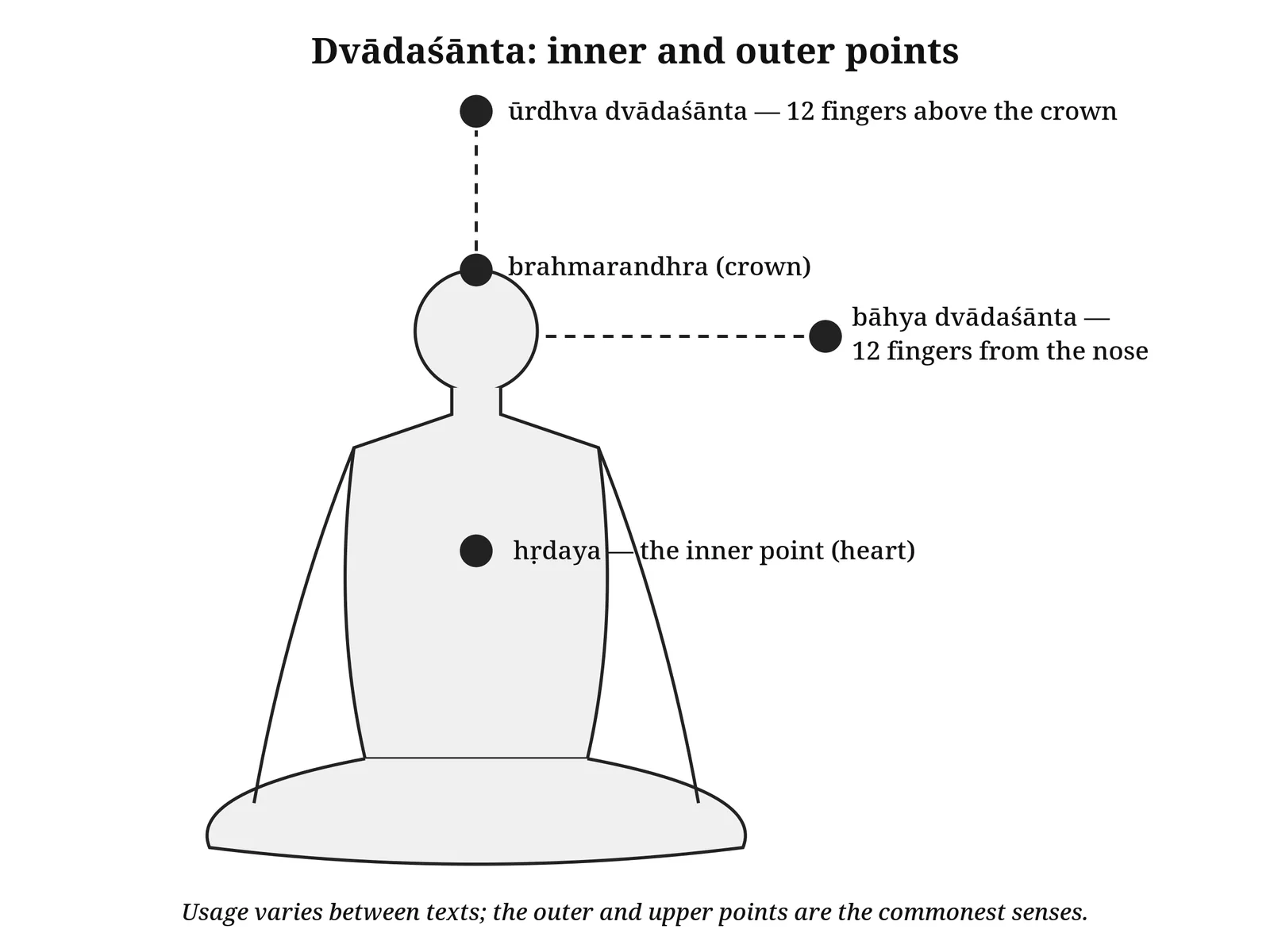
Interpretation (elaborative): The phrases yathā tathā and yatra tatra are deliberately casual: "somehow, somewhere". The practice is not restricted to formal meditation or special postures. Whether walking, eating, working or resting, one should throw (kṣipet) the mind into the dvādaśānta. The verb kṣip, to throw, suggests a quick, light movement, like tossing a ball. It is not a laborious concentration but a frequent, easy redirection of attention. Kṣemarāja comments that the dvādaśānta here can be any of the dvādaśāntas — outside the nose, above the head, or even at the end of any sense-perception. The point is to send awareness beyond the habitual centre of the ego. For the practitioner, this is a practice of "frequent remembering". Throughout the day, whenever you remember, toss your attention to the space above your head or a little in front of the face. Do it lightly, for a moment, and return to your activity. Over time, this habit loosens the mind's identification with its usual concerns. It is like the practice of smaraṇa, constant remembrance, found in devotional traditions, but directed toward the open space of awareness rather than a deity's name. The repetition yathā tathā yatra tatra, "in whatever way and wherever", removes all formal requirements: no posture, place or time is prescribed. Śivopādhyāya sees this as one of the most liberating instructions of the Tantra, making the practice compatible with any lifestyle. A householder, a worker, a traveller can all practise it. The only requirement is the repeated, gentle placing of the mind in the dvādaśānta, a habit that can be cultivated through countless small moments.
2. प्रतिक्षणं क्षीणवृत्तेर्वैलक्षण्यं दिनैर्भवेत् (pratikṣaṇaṃ kṣīṇa-vṛtter vailakṣaṇyaṃ dinair bhavet):
“For one whose mental activity diminishes moment by moment, an extraordinary state arises within days.”
- प्रतिक्षणम् (pratikṣaṇam) (avyayībhāva cpd.; indecl.): Moment by moment — at every moment.
- क्षीणवृत्तेः (kṣīṇavṛtteḥ) (bahuvrīhi; kṣīṇa ← √kṣi, p.p.p.; vṛtti ← √vṛt; gen. sg. m.): For one whose mental activity diminishes — of one whose mental fluctuations are diminished; kṣīṇa (“wasted, diminished”) + vṛtti, genitive.
- वैलक्षण्यम् (vailakṣaṇyam) (vṛddhi abstract of vilakṣaṇa; nom. sg. n.): Extraordinariness, a unique state; abstract of vilakṣaṇa (“different, extraordinary”).
- दिनैः (dinaiḥ) (instr. pl. n. of dina): Within days; instrumental plural of dina.
- भवेत् (bhavet) (√bhū, 1P; opt. 3sg.): Arises.
Interpretation (elaborative): The result: pratikṣaṇaṃ kṣīṇa-vṛtteḥ, for one whose vṛttis diminish every moment. Vṛtti is the term used by Patañjali for the fluctuations of the mind (citta-vṛtti); yoga is their cessation (nirodha). The Tantra uses the same term: as one repeatedly casts the mind into the dvādaśānta, the vṛttis become weaker and fewer. Then dinair bhavet, "within days", there arises vailakṣaṇya, an extraordinary state. Vilakṣaṇa means "different, unusual, beyond the ordinary". The state is extraordinary in that it is different from all ordinary states of waking, dreaming and sleeping: it is the turya, the fourth state, or a taste of Bhairava's nature. The promise of results "within days" is typical of the Vijñāna Bhairava, which emphasises the immediacy of its methods. For the practitioner, this is encouraging. Constant, light practice can produce noticeable change quickly. One may notice a growing calmness, a sense of lightness or space, an ability to observe thoughts without being caught by them. These are signs that the vṛttis are diminishing. The "extraordinary state" may arrive suddenly, as a moment of profound clarity, or gradually, as a growing background of peace. Either way, it is the fruit of consistent remembrance. The phrase dinair bhavet, "it happens in days", is an encouraging promise. Kṣemarāja interprets vailakṣaṇya, "extraordinary distinctiveness", as a perceptible change in the quality of one's being: increased calm, clarity and a subtle joy that others too may notice. The practice works not through dramatic experiences but through the cumulative effect of countless brief returns to the source, each one wearing away a little of the habitual agitation of the mind.
Practice Guide
Practice Guide — Dhāraṇā 28 (verse 51)
Preparation & Posture
This is both a sitting practice and a practice for daily life. Sit upright, eyes closed, for the formal part. Become familiar with Dhāraṇā 27 first. Breathe naturally and let the body settle.
Step-by-Step Method
1. Bring attention to the dvādaśānta, above the crown or beyond the nose.
2. Cast the mind into it, as the verse says, letting thoughts dissolve there.
3. Do this "in whatever way" works for you: through the breath ending outside, through attention above the head, or simply by remembering the point.
4. During the day, return the mind to the dvādaśānta "wherever" you are: when walking, working or resting.
5. Each time, let the mental activity diminish a little.
6. Notice how thoughts become fewer and softer over time.
7. Continue the practice consistently for days and weeks.
8. Expect, as the verse promises, an extraordinary state to arise "within days", but do not seek it.
What to notice. In the first days the returns to the dvādaśānta feel deliberate and are easily forgotten. Later they begin to happen by themselves, and each return brings a small drop in mental noise. Notice how the background chatter grows quieter over the day. The "extraordinary state" is usually not dramatic: it is a clear, light openness that begins to remain between the returns.
Beginner variation: three times a day, take three breaths, resting attention at the point where the out-breath ends outside the nose.
Duration & Frequency
Beginners: 10 minutes of sitting daily, plus brief moments during the day. Established practitioners: frequent returns throughout the day, with longer sittings.
Signs of Progress
Mental activity diminishes moment by moment; a sense of lightness and openness during the day; an unusual, peaceful clarity that begins to colour ordinary activity.
Common Mistakes
Forcing the practice; becoming obsessive about returning to the point; losing grounding; neglecting ordinary responsibilities.
Cautions
If you feel light-headed or ungrounded, end each return by feeling the feet. Keep the practice relaxed and do not use it while driving or operating machinery.
Integration into Daily Life
Whenever you stand up, rest attention above the head for one breath.
Related dhāraṇās: continues Dhāraṇā 27; compare Dhāraṇā 1 (verse 24) and see Figure 6.
Traditional guidance, not medical advice; see “A Note on Safe Practice” in the Introduction.