Explanation
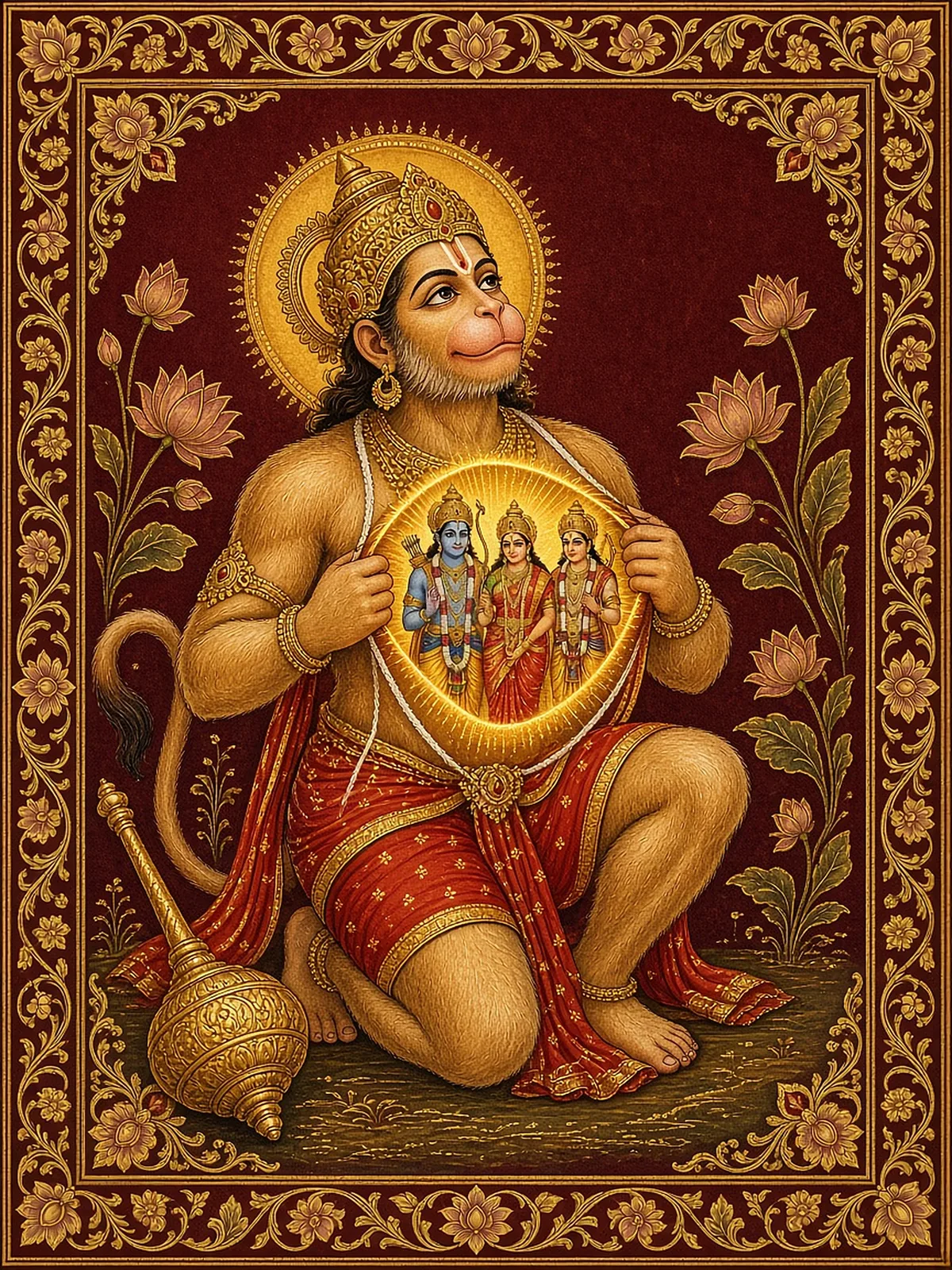
The Hanumān Cālīsā closes with a dohā that gathers the whole hymn into a single prayer. Hanumān is addressed by three titles — Pavanatanaya, son of the Wind; Saṅkaṭa-harana, remover of crises; and Maṅgala-mūrati-rūpa, the very form and embodiment of auspiciousness — and is then called Sura-bhūpa, king among the gods. The prayer is that he dwell (basahu) in the heart (hṛdaya) together with (sahita) Rāma, Lakṣmaṇa and Sītā. This completes the request of verse 40 (“make your dwelling in my heart”) and makes explicit what it implied: Hanumān should not come alone, but with the divine family he himself carries in his heart (verse 8). The Cālīsā thus ends where all true devotion ends — with the Divine enthroned in the heart. The opening dohās began with the purification of the mind and a prayer for strength, intelligence and knowledge; the closing dohā ends with the heart become a temple. The devotional intent is to leave the devotee not with a list of benefits, but with a living presence.
Detailed Explanation
1. पवनतनय संकट हरन, मंगल मूरति रूप (pavanatanaya saṃkaṭa harana, maṃgala mūrati rūpa):
“O Son of the Wind, remover of crises, embodiment of auspiciousness!”
- पवनतनय (pavanatanaya): Son of the Wind — pavana (wind, Vāyu) + tanaya (son).
- संकट (saṃkaṭa): Crisis / distress / danger.
- हरन (harana): Remover / one who takes away (Sanskrit haraṇa).
- मंगल (maṃgala): Auspiciousness / well-being / blessedness.
- मूरति (mūrati): Image / form / embodiment (Sanskrit mūrti).
- रूप (rūpa): Form / nature — maṃgala mūrati rūpa, “whose very form is the image of auspiciousness”.
Interpretation (elaborative):
The closing dohā gathers three essential aspects of Hanumān in one line. Pavanatanaya recalls his origin as the son of Vāyu — the life-breath, swift, subtle, all-pervading — and connects with Dohā 2, where the poet said “sumirauṁ pavana-kumāra”. The hymn begins and ends with the son of the Wind. Saṅkaṭa-harana, remover of crises, sums up the protective verses of the Cālīsā (verses 20–26, 36): the devotee who has heard of Hanumān’s power to cut through every difficulty now addresses him by that very title. In popular devotion this title, together with Saṅkaṭamocana, is among the most beloved of all Hanumān’s names. Maṅgala-mūrati-rūpa, the embodiment of auspiciousness, adds something new. Hanumān is not only a remover of evil but a positive presence of good. Maṅgala means auspiciousness, blessedness, well-being — all that is favourable and holy. Hanumān’s very form is maṅgala; to see him, to remember him, is itself a blessing. This is why Tuesday (Maṅgalavāra) is especially associated with his worship in North India, and why his image is placed at the entrance of homes and the start of journeys. The three titles also form a progression: origin (Pavanatanaya), action (saṅkaṭa harana) and essence (maṅgala mūrati). We know Hanumān first by his birth, then by his deeds, and finally by his very being, which is blessing itself. Practically, this line can be used on its own as a short prayer of protection and blessing, especially at the start of a day or a journey. It reminds us that the presence we invoke is not only strong but kind — the very image of all that is good.
2. राम लखन सीता सहित, हृदय बसहु सुर भूप (rāma lakhana sītā sahita, hṛdaya basahu sura bhūpa):
“Together with Śrī Rāma, Lakṣmaṇa and Sītā, dwell in my heart, O King among the gods.”
- राम (rāma): Śrī Rāma.
- लखन (lakhana): Lakṣmaṇa.
- सीता (sītā): Sītā.
- सहित (sahita): Together with / accompanied by.
- हृदय (hṛdaya): Heart.
- बसहु (basahu): Please dwell / reside (respectful imperative of basanā).
- सुर (sura): Gods / divine beings.
- भूप (bhūpa): King / lord (literally “protector of the earth”); sura bhūpa, “king among the gods”.
Interpretation (elaborative):
This is the final prayer of the Cālīsā, and it is a prayer for the fullness of the Divine presence. The devotee does not ask for Hanumān alone, but for Hanumān with Rāma, Lakṣmaṇa and Sītā — the complete divine family as it is depicted in countless temples and household shrines: Rāma and Sītā enthroned, Lakṣmaṇa standing beside them, and Hanumān at their feet. The devotee asks that this sacred scene be established in his own heart. Each member of the family brings something. Rāma is the Supreme, the goal of all devotion, the embodiment of dharma. Sītā is grace, compassion, the Divine Mother whose boons empower Hanumān. Lakṣmaṇa is the ideal of vigilant, devoted service and brotherly love. Hanumān is the bridge, the servant, the protector who makes the heart a safe dwelling for them all. Together they represent the perfection of the spiritual life: the Lord, His grace, His devoted service, and His protecting presence. The address sura bhūpa, king among the gods, is the final exaltation of Hanumān. Throughout the hymn he has appeared as a servant; now, at the end, he is called a king. This is the paradox of devotion: the one who becomes the servant of all becomes the king of all. Hanumān, who sought nothing for himself, is honoured above the gods. The verb basahu, “please dwell”, is a gentle, respectful imperative, an invitation rather than a command. It echoes verse 8 (mana basiyā) and verse 40 (hṛdaya mahaṃ ḍerā). The Cālīsā has been, from beginning to end, an invitation for the Divine to come and live within us. Practically, the closing dohā is the moment to pause after recitation, close the eyes, and visualise Sītā-Rāma, Lakṣmaṇa and Hanumān seated in the heart. Many devotees end with the traditional acclamations — “bolo siyāvara rāmacandra kī jaya, pavanasuta hanumāna kī jaya” — and carry that inner image into the rest of the day.