Explanation
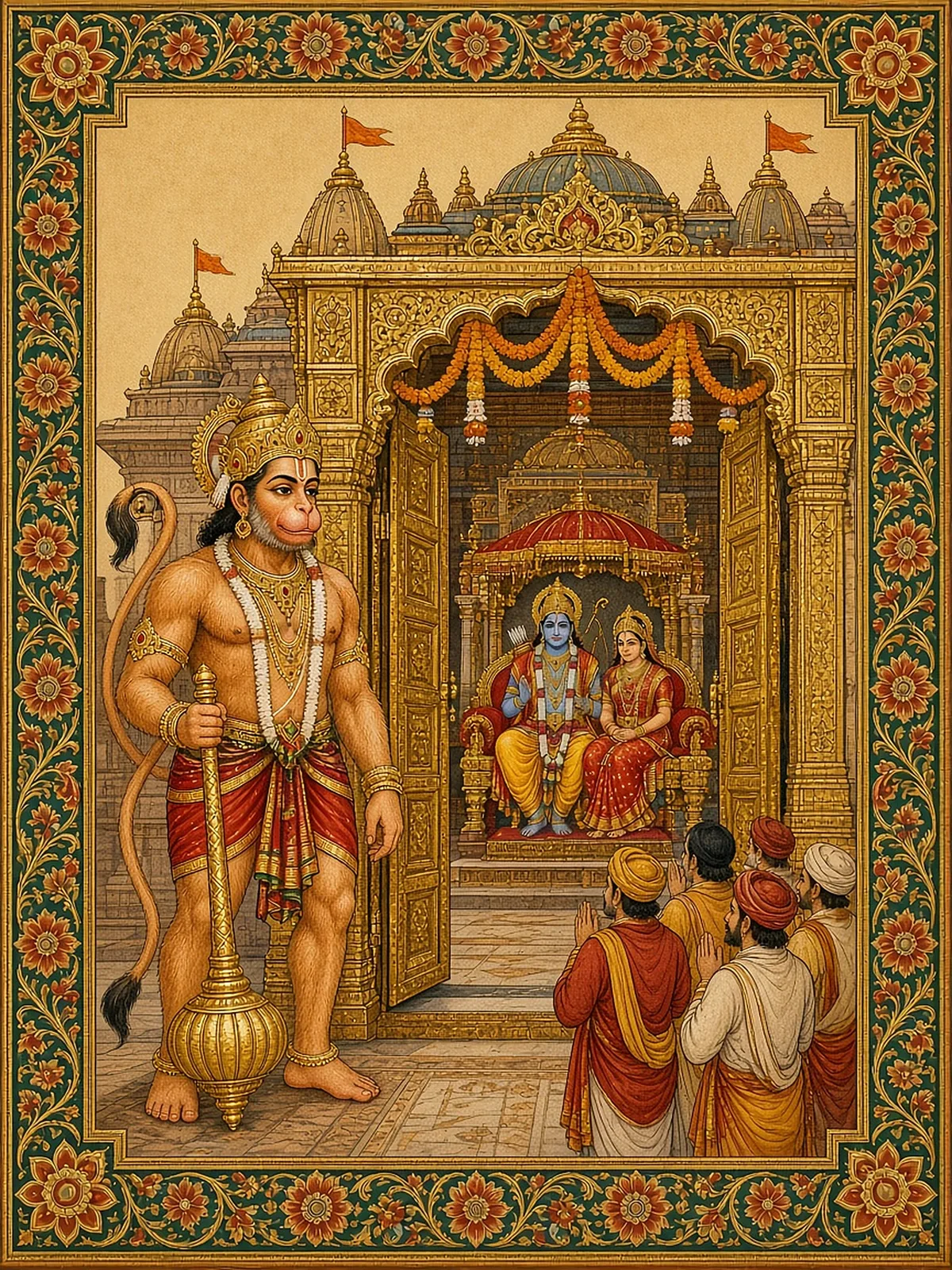
This caupāī presents Hanumān as the doorkeeper (dvārapāla) of Rāma’s court. In iconography and devotion, Hanumān is commonly depicted at the feet or by the side of Śrī Rāma, Sītā and Lakṣmaṇa, and in countless temples he stands at the entrance. The verse says that entry into Rāma’s presence (paisāra) does not happen (hota na) without his permission (ājñā). The meaning is spiritual: to reach Rāma, one must pass through Hanumān — that is, through the qualities he embodies (devotion, service, humility, purity) and through his grace. This idea is common in bhakti theology, where the devotee or Guru is the gateway to God. Tulasīdāsa himself, in his works, approaches Rāma through Hanumān, asking him to intercede. The devotional intent is to establish Hanumān as the indispensable intercessor, the loving gatekeeper who welcomes the sincere and keeps away what is impure.
Detailed Explanation
1. राम दुआरे तुम रखवारे (rāma duāre tuma rakhavāre):
“You are the guardian at Śrī Rāma’s door.”
- राम (rāma): Śrī Rāma.
- दुआरे (duāre): At the door / gate (Sanskrit dvāra).
- तुम (tuma): You.
- रखवारे (rakhavāre): Guardian / keeper / protector (from rakhanā, to keep, guard; Sanskrit rakṣa).
Interpretation (elaborative):
In the ancient Indian palace, the doorkeeper held a position of great trust. He knew the king’s will, protected his privacy and safety, and decided who could be admitted. Hanumān is the doorkeeper of Rāma in this sense — the most trusted of servants. Popular tradition beautifully extends this: after Rāma’s coronation in Ayodhyā, Hanumān remained close to Rāma, serving him personally, and in many traditions of Ayodhyā he is honoured as the guardian of the city; the famous Hanumān Gaṛhī temple in Ayodhyā reflects this belief. In temple architecture, Hanumān often stands before shrines of Rāma, facing the Lord with folded hands. Pilgrims customarily pay respects to him before or after entering Rāma’s presence. The image is not of a fierce guard who keeps devotees out, but of a loving guardian who brings them in. To be a doorkeeper is also to stand at the threshold — between the outer world and the inner sanctum. Hanumān stands at the threshold between our ordinary life and the presence of God. Every devotee must cross that threshold, and Hanumān is there to help. Some commentators also interpret Rāma duāra as the heart, where Rāma dwells. Hanumān guards the heart so that worldly distractions and evil tendencies cannot enter and disturb the Lord’s presence. The image is also one of constancy: a doorkeeper does not leave his post. Hanumān is always at the door, always awake, always available, whatever the hour. Practically, this line encourages devotees to approach God through humility and service — the qualities of Hanumān — and to make Hanumān the guardian of their hearts, so that nothing unworthy may enter there.
2. होत न आज्ञा बिनु पैसारे (hota na ājñā binu paisāre):
“No one can enter without your permission.”
- होत (hota): Happens / takes place.
- न (na): Not.
- आज्ञा (ājñā): Permission / command / order.
- बिनु (binu): Without (Sanskrit vinā).
- पैसारे (paisāre): Entry / admission — the Hindī Śabdasāgara gives paisāra as “entry, entrance” (from paisanā, to enter), and the Mahāvīrī commentary glosses it praveśa.
Interpretation (elaborative):
This line is sometimes misunderstood as meaning that Hanumān restricts access to Rāma. In fact, its emphasis is the opposite: with Hanumān’s permission, entry is assured. He is the means of access, not a barrier. If you have Hanumān’s favour, you have access to Rāma. The theological principle is widespread in bhakti: the Lord is approached through His devotees. Tulasīdāsa in the Mānasa constantly praises the company of saints (satsaṅga) as the means to devotion, saying that without satsaṅga there is no discrimination, and that satsaṅga cannot be had without Rāma’s grace. Similarly, in many devotional traditions the Lord is approached through His dear devotees — Hanumān for Rāma, Garuḍa for Viṣṇu, Nandī for Śiva. Pleasing the devotee pleases the Lord. It is also true that some things cannot pass Hanumān. Pride, hypocrisy and wickedness do not get through. Rāvaṇa met Hanumān and, because of his arrogance, did not reach Rāma as a devotee; he met Rāma only on the battlefield. Vibhīṣaṇa met Hanumān with humility and was led to Rāma as a beloved refugee. So Hanumān’s permission is not arbitrary; it is the natural result of the devotee’s sincerity. The word ājñā here also suggests that Hanumān’s “permission” is itself an act of grace: he does not merely allow entry, he invites and accompanies. Practically, this line encourages us to cultivate a relationship with Hanumān as the friendly guardian who will lead us to Rāma. When we chant the Cālīsā, we are, as it were, knocking at the door; Hanumān hears, and opens. It also reminds us to examine ourselves: are we bringing to the door the qualities that Hanumān welcomes — humility, sincerity, devotion?